
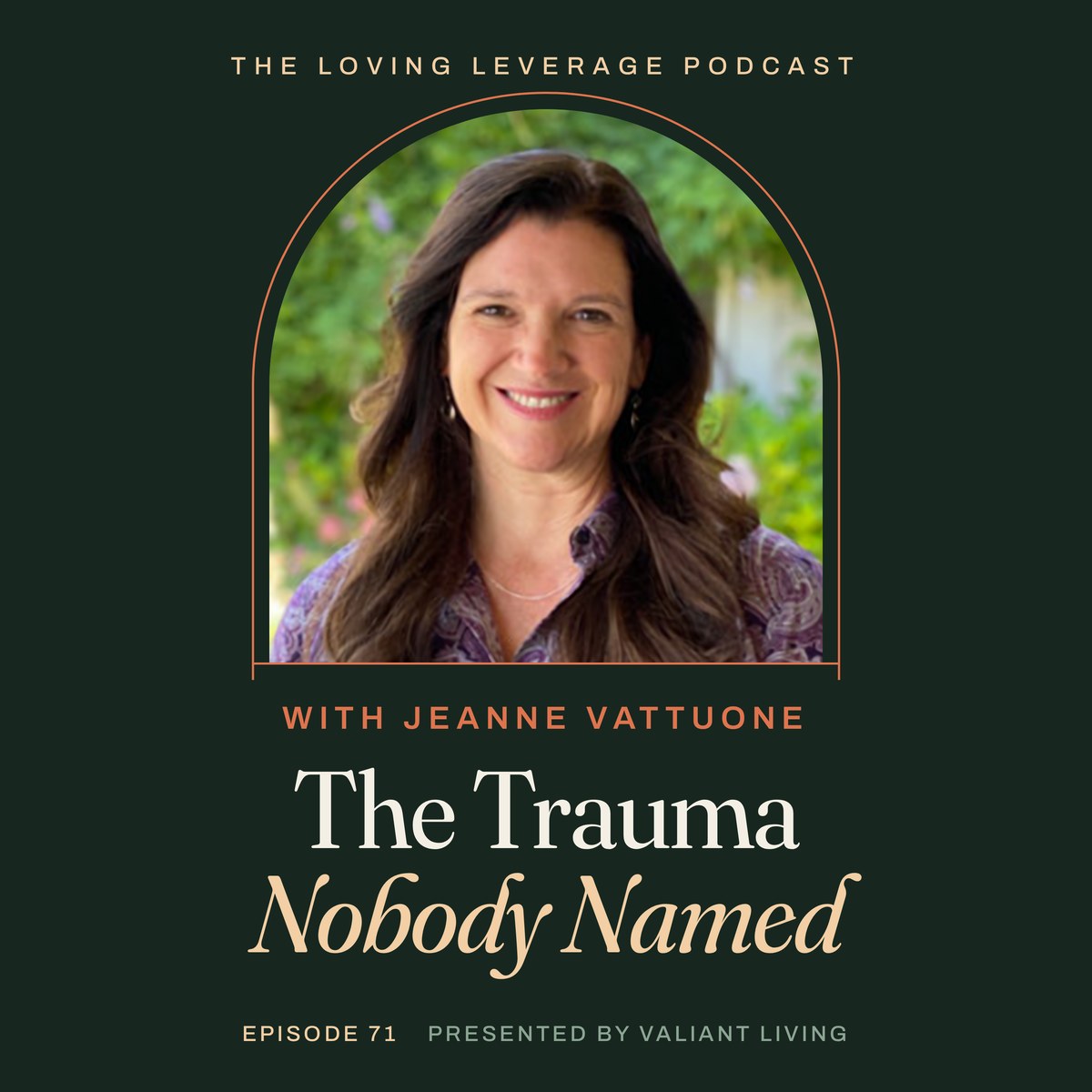
Episode 71 · The Loving Leverage Podcast
The cofounder of Willow Tree Healing and Recovery on what discovery does to a partner, why trauma care comes first, and how a structured disclosure becomes the starting line for repair.
Discovery doesn't only hurt. For many partners it shakes their sense of reality, safety, and trust in their own judgment. And for years, the helping world told those partners they were part of the problem.
Jeanne Vattuone has spent her career changing that. She is a Licensed Clinical Social Worker, a certified sex addiction therapist and supervisor, a certified partner trauma therapist, cofounder of Willow Tree Healing and Recovery in Santa Rosa, California, and coauthor of the workbook Finding the Way Through. When she booked this episode, she asked to build the whole conversation around one thing: partner sensitivity.
Host Drew Powell, an alumnus of the Valiant Living men's treatment program, sits down with Jeanne to talk about what betrayal trauma actually does to a partner, what helps and what harms in the first days after discovery, and why a structured therapeutic disclosure is where repair begins, not where it ends.
Watch the episode
Prefer to listen?
Chapters
Why it matters
Everything in this conversation sits inside the Loving Leverage™ framework, created by Valiant Living founder Michael Dinneen, LCSW, CSAT-S. The partner's healing isn't a side project to the man's recovery. It's part of how a family moves from addiction to connection.
Jeanne describes the same shift we see in the men who come through our program. Early on, a man does the right things because he has to. Over time, the goal is integrity: doing the next right thing because that's the man he wants to be, and building the kind of relationship where his partner doesn't have to live in fear. That's the 2.0 version Jeanne wants for both people.
If you're a partner who has just discovered betrayal, you don't have to carry this alone. Start with our resources for spouses and partners. If the man you love is caught in sex addiction or the aftermath of infidelity, we can help you understand what treatment looks like, including how our family support track brings partners into the work.
This is episode 71. The previous episode was Ian and Roxcy Brown on love without rescuing. Find every episode of The Loving Leverage Podcast here.
About the guest
Jeanne Vattuone, LCSW, CSAT-S, CCPS-S, CPTT-S, has been a Licensed Clinical Social Worker since 1998. She spent the first half of her career in trauma work with high risk children, youth, and families through child protective services, foster care, residential treatment, and private practice. In 2009, after moving her practice to Santa Rosa, California, she began specializing in sex addiction and partner trauma, at a time when the coaddict model was still the prevailing approach for betrayed partners.
Jeanne trained under Dr. Patrick Carnes and cofounded Willow Tree Healing and Recovery with Tim Stein, LMFT, CSAT-S. Willow Tree provides specialized care for betrayal healing and sexual recovery through individual, couples, and group therapy, workshops, and structured therapeutic disclosure. She is a longtime leader and board member of APSATS, the organization that helped the field name betrayal trauma and train clinicians in a partner sensitive approach. With Tim Stein, she coauthored Finding the Way Through, a sex addiction recovery workbook that brings the betrayed partner's perspective into every chapter.
Questions people ask
Betrayal trauma describes the trauma response many partners experience after discovering a partner's hidden sexual behavior and deception. It can include shock, hypervigilance, sleeplessness, and a shaken sense of reality. Jeanne Vattuone explains that viewing partners through a trauma lens fits the vast majority of betrayed partners far better than older models that treated them as coaddicts.
Partner sensitivity means the betrayed partner's experience stays central throughout treatment of the person with the compulsive sexual behavior. It shapes how clinicians talk about discovery, how recovery work is structured, and how disclosure is handled, so the partner is not harmed again by the process meant to help.
A therapeutic disclosure is a structured, clinician guided process in which the person with the compulsive behavior shares the full factual truth with their partner. At Willow Tree it is an intervention of truth telling, not a decision about whether to stay in the relationship. It is typically spread over two days so the partner has time to process and get support, and it is a launch point for repair, not the end of the conversation.
Yes. Jeanne Vattuone says more betrayed men are seeking help than ever, and that the field needs to move away from language that assumes the betrayed partner is always a woman. Her workbook, Finding the Way Through, uses gender inclusive language throughout, and half of its case vignettes describe women with compulsive sexual behavior.
Loving Leverage™ is a framework created by Valiant Living founder Michael Dinneen, LCSW, CSAT-S. It's built on the idea that love, not shame, is the most powerful force for lasting recovery, and that the people who love a man can become the leverage that gets him help when they refuse to give up on him and refuse to enable him.
Drew: Welcome to episode 71 of The Loving Leverage Podcast presented by Valiant Living. I'm Drew Powell, I'm a recovery advocate and alumnus of the Valiant Living men's program, and this is a show about what it takes to move from addiction to connection. My guest today is Jeanne Vattuone. Jeanne is a licensed clinical social worker, a certified sex addiction therapist and supervisor, a certified partner trauma therapist, and co-founder of Willow Tree Healing and Recovery. She's also co-author of the workbook Finding the Way Through. When we booked this episode, Jeanne asked to build the whole conversation around one thing, and that is partner sensitivity. And here's why that matters. So much of the recovery world is built around the man, his behavior, his treatment, his sobriety. Meanwhile, the person who discovered the betrayal is often left holding a kind of trauma that nobody really named for her. And sometimes she's told just to be supportive and get out of the way. And Jeanne has spent her career pushing back on that. In this conversation, she walks us through what betrayal trauma actually does to a partner, why the way a man handles disclosure can either deepen the wound or start to heal it. And what has to be true on both sides before relational repair is even possible. So if you're the partner who's been carrying this alone, or you're the man who wants to understand what she's really going through, this episode is for you. Alright, so here's my conversation with Jeanne Vattuone. Well, thank you for joining us on the The Loving Leverage Podcast. I'm still getting used to saying that because we rebranded, but Jeanne Vattuone on here with Willow Tree. Author. I'm going to mess up all your you got CSAT, CPTT. I mean, you got, I think everyone that there is the get, you got.
Jeanne: And I'm a supervisor for them all.
Drew: You're a supervisor for them all. Doing incredible work in this space, specifically with betrayed partners, but also we were talking about betrayed men. I want to get into all of that if you're willing to. But tell me a little bit about your story, licensed clinical social worker, trained directly with Dr. Patrick Carnes, which I we hold in very high regard. So take us back to the beginning. What drew you into this work and what has kept you doing really one of the hardest, hardest things to do in the last three decades?
Jeanne: Yeah, no, so true. Yeah, so I the first half of my career, I was working with trauma. So I worked with traumatized kids and youth, high risk. I worked with them and their families, and a lot of their families had addiction in their past. I worked in child protective services, foster care, residential treatment, and then doing a lot of trauma work in private practice. I moved after about 15, 16 years in my practice up to a different town, which is where I am now, Santa Rosa, California, just north of San Francisco. And I was in a consultation group with my current business partner, Tim Stein, and he was just starting to talk about sex addiction. And back then, this is 2009, back then the co-addict model was the prevailing treatment model for betrayed partners. And I had not heard of this, and I was very intrigued, and I did not understand it. So when he was talking about betrayed partners, I was thinking, that's trauma. And I've been doing trauma years and years. So I basically said, Can I redo this? Let me change the case consult the conceptualization. How are we going to look at this? And that was new. That was new in the field. You know, there were other folks doing it in the world, but we couldn't find that. And so that really started the working together because these people are working so incredibly hard and their loved ones, the ones who are struggling with compulsive sexual behavior. So that started it back in 2009. And of course, like you said, CSAT, CSAT supervisor, CPTT, CCPS with APSATS. Being a being a strong part of that organization, which is Association of Partners of Sex Addict Trauma Specialists. Yeah. And what keeps me in this work are my clients. My clients, my team, because our clients work so incredibly hard. And I I see change, I see marriage 2.0, person 2.0. And I've got a great team. Been working with Tim for the last, you know, 17 years now. Wow. So having a team to help, and we work in a systems approach. So we're we're talking and working for the family. Yeah.
Drew: And I'll say right from the beginning, we'll talk about this more later, but the work you're doing with Tim with Finding the Way Through, and really, I mean, an incredible resource that can be used in this space. Can can you just right at the right off the top, just give an overview of that? And we'll dig in a little bit later, but I don't want people to wait to the end to talk about that. I want to talk right up the front of that work that you're doing with that resource.
Jeanne: Yeah. So the book is Finding the Way Through, and it is a sex addiction workbook. So it's for towards the person with the compulsive sexual behavior. What makes this workbook very different is the first half of the book is sobriety, really. The second half is recovery. And throughout the whole book, it is educating and bringing in the perspective of the betrayed. So every chapter has a section of partner sensitivity. Hey, given this chapter, this is what's going on with your betrayed partner, possibly. Here's some things I need you to think about. Here are some metaphors to help you get perspective. Here's what a betrayed partner may go through in their treatment healing journey. So it's so full of partner sensitivity while also having really strong recovery work.
Drew: Can I can I take you down a rabbit hole real quick?
Jeanne: Let's go.
Drew: Sobriety versus recovery. What is the difference? Because I love that you I've heard people use that almost like it's the same, and I believe it's different, but I want to hear your, I want to hear why you're distinguishing those two.
Jeanne: For us, for us, and when I say us, I'm referring to Willow Tree. Tim Stein and I and our team, we we think of addiction treatment as three steps get sober, number one. Number two, learn to stay sober in this world. And then number three, why are you an addict in the first place? So sobriety work is the don't do. What are you abstaining from? And how do you not do that? Recovery is how do you not do that in this world? And how do you change who you are? How do you live differently? So that could be communication, that could be prioritization, that could be moving out of the all and none and more into the moderation and having balance in your life. So recovery is living differently. Sobriety is don't do. So Dan Drake, he has the phrase, and I'm gonna get it wrong. Sorry, Dan. But you know, sobriety is required for recovery. You can't get to recovery without so that's why the front half of the book is very behavioral. And then we start getting into why do you think and how do these behaviors connect with core wounds? And what core wounds and what attachment and what trauma might be there, developmental, capital T. And how are you gonna keep that going in relational healing? So Finding the Way Through is relational healing, betrayal trauma, and addiction work. It's available on Amazon, by the way.
Drew: Yeah, and we'll link to all that too. I want people to get that because it's it's really it's really be becoming kind of the leader in this space for doing this work. I mean, it's it's almost, you know, what what I believe could could really be the industry standard for this is the go-to resource to really look at all parties involved and to help them. And I and thank you for explaining this because I do feel like the temptation for me, a lot of my friends that are in recovery, or even I should say sobriety, like they they get in the rooms and they're they're abstaining from doing the thing, but there's also this whole other door to open into recovery. And even the way you say that, like I have viewed as like I want to recover, I want to go back and recover my feelings that I didn't feel. I want to recover my heart, I want to recover how I show up in the world. Like it's getting back what I lost in some ways, too, you know. And so thank you for making it or creating I like that.
Jeanne: Yeah, that's why I use I use just this nomenclature of 2.0. Like who am I, 2.0 version of me. Right now that I've come out of this really hard, difficult, painful experience as I'm emerging. Who do I want to be? What are my what are my values? What are my principles in the world?
Drew: Yeah, it's so good.
Drew: It's so good. And you mentioned APSATS. I just want to pause there for a second and thank you for the work that you've done with that. You you're still currently on the board. You ran point for that organization for a long time. We were just at the conference this last year. My wife and I and Valiant Living was there, and and we were just kind of we were emotional about with gratitude that this exists for our betrayed partners and how much more we have to go to really bring this education and this community to people who are hurting and struggling. But we just walked through and and I remember my wife saying, I'm so glad these resources exist because you know, she's betrayed partner, she's walking in it. So for her personally, but also for her friends that are just going through discovery and all that. And so what a fantastic organization that you've helped lead and run point for. And I want to kind of drill down on that a little bit because a lot of people have heard of addiction treatment. Fewer people have heard of betrayal trauma. And for the person listening, what is actually happening inside a partner, a wife, a husband in the days after discovery? What is going on during that that part in that time?
Jeanne: In that acute phase right after discovery?
Drew: Yeah, because I think some there's there's just so many unhelpful is that a is that a kind way of saying it? And and I will say well-meaning people saying unhelpful things, yes, and there just needs to be more understanding, I think, of what is actually happening in this person before we start labeling them a codependent or a whatever.
Jeanne: Yeah, yeah.
Drew: Talk through a lot of things.
Jeanne: This is a passion project for me. Okay, because it's it's and I'm so thankful for APSATS for all the and all the people who created APSATS, continue to run APSATS, be a part of APSATS, and everybody reminder, APSATS.org. It's a nonprofit organization. It trains coaches and clinicians. And so when we have a conference, we do invite betrayed partners to the conference. There's a betrayed partner track, yeah, and then there's a professional track. So, but APSATS.org will give you more information. It's in the spring, by the way. Following those discovery days, usually one or two things happened. One, somebody may go quiet. It's the fight, flight, freeze. Sometimes you people have heard about that. It's the freeze, it's the I can't believe just what happened. I don't, I'm trying to make sense of it. I don't know what to do with this, I don't know who to tell. And PS, I can't get out of bed, and my kids are yelling at me because I need to drive them to school today. Right. So sometimes it's just like the the the walls go down and there's the freeze. Some folks go into a high reaction mode, which might be lots of emotion, lots of telling people that sometimes they wish they hadn't. And it's a it for some people it's a slow trickle. For some people, it's a complete shatter. But it's absolutely a crisis, life-changing kind of moments and days.
Jeanne: Yeah, what's what's helpful? I'm gonna go for there first. What's helpful by chance if you know someone who's going through this, it's I'm so sorry, how can I help you? I'm here for you. I don't judge you. I don't judge your partner. What can I do? Would you like me to bring some chicken casserole over? Would you like me to take you out to the park? Would you like to go go get a cup of tea? So being non-judgmental and just open is the best thing a friend, a peer, a pastor, a family member can do when someone has this discovery.
Drew: Yeah. And don't you think, just to pause right there, don't you think I'll I'll make it personal. There's been times where I've wanted so badly to help, and I'm looking for what's the right piece of advice, or I even need to side with them. I can't believe he or she would do that. How like so unintentionally, we're trying to jump in and show support with advice, and it could be anything from, you know, leave him. What's that?
Jeanne: Leave her, you know, divorce her.
Drew: Or you gotta forgive him.
Jeanne: Yeah, he confessed, why not? Like, let's let's go to church and pray. Everything will be all right after that. Yeah, the advice giving, I would say just stay out of that. When someone starts to give advice, right there, they think they know what you need. And you may not know what you need. Right, right. And and this goes for professionals. This is why I speak I speak at a national level, but I also speak in my local community because I'm trying to get the word out to my local clinical community of hey, you may have a betrayed partner sitting on your couch, and when you say everybody does it or just have more sex, that is treatment trauma because you may not know the full the full of what's going on. I mean, I remember speaking to a we we got invited to speak with this very large legal association, an attorney association for family attorneys. And after explaining about sex addiction and betrayed partners, we had so many people come up to us. Now I understand what my client was going through. I said completely the wrong thing. And thank you because now I won't say those things anymore. So ad advocating getting out into the world. Yeah, it's not helpful to say, just watch more porn with them. That's not helpful.
Drew: And that happens. Don't you think it's more about how it makes me feel as the person giving advice? Like I'm trying to almost, I want them to feel better, but in some ways, like me giving advice to someone in that moment is me trying to me feel better about what's going on and feel like I'm like, as opposed to just sitting with them in the pain and grieving and just being just being near, like you were saying, just being with. Like, I don't feel like I have to help them fix this, or my codependency doesn't need to take in and be like, okay, I gotta, I gotta rescue you from this, or with something I need to say. And I want to show grace because I I do think most people are really trying to help, like not trying to hurt. And I think that's why this teaching is so important.
Jeanne: And so I would say if you're a betrayed person and you might have an idea of what you need, that could be very helpful to your friends, family around you to say, hey, actually, I just need you to listen. Or hey, can you do you have capacity to hear me? Right. Or can you not ask me about it and can we just hang out and go to the game? Like sometimes you need sometimes betrayed partners need to take a break from it too.
Drew: Right. I just can't talk about it right now. I need to, yeah. Yeah, I mean, when I was in treatment, it was interesting because my family at one point, I was doing calls with them in the evening with my kids. And at one point the therapist came and said, Hey, we're gonna cut this back, we're gonna do we're gonna do one call a week if they want to. And it was really great for them because one thing I I didn't realize is every time you call, every night when you call, they're trying to like survive this season, they're trying to get through it. And you every evening they're reminded again that their dad's not home, their dad's in treatment, their life's up, like they need a little bit of normalcy. They don't need an every night reminder. And when I was told that, of course, at first I was upset because I wanted to talk to them, but then I was like, oh, that makes sense. Like, I don't want them to have to feel because I was even starting to feel it a little bit on the calls, too. Like, this is it's just getting a little too much. I could feel off. But is that part of what the old model, the old like viewing them as codependents, is that part of what what that old model kind of got wrong, and what this new like partner sensitive care gets right? Is that kind of what we're talking about?
Jeanne: I I don't I don't know how to answer that question necessarily, but if I change it a little bit, the previous way of thinking was what we had at the time, is what I say. That's what we had, that's what we knew, that's what made sense. We were trying to kind of make a match between what was out in the in the key in the helping community and the clients coming forward that may have matched for some, and it just really, really didn't match for others. Betrayal or trauma from a you know, using a trauma lens matches like 95% of the people. Do they feel that trauma as a as a giant 10 out of 10, or do they feel the trauma as a four out of 10? Everyone's different, but that sense of betrayal and having often trauma symptomology, not everybody, but often trauma symptomology, that's more of a match. So it's kind of like we knew what we knew, and then we knew more, and then we collected data and did research and went, oh, this is a better match. And of course, the client response was, now you got me. Now I feel understood. Right, right. So I think it was just an evolution of the field.
Drew: Yeah, that's a I think that's a really generous way of talking about it. And I and to your point, I think what we've started to see somewhat valiant is when when we're able to help with the healing process, the the other stuff, like the things that they need to look at and be and be responsible for and whatever, that normally comes naturally down the road as they begin to heal. They begin to realize, oh, maybe there's something I need to look at, or maybe there's something I need to, but I think sometimes starting with you know, you gotta work on this or you got some codependency issues. I was like, man, I maybe, but I gotta heal. Like I'm I'm really hurting. Yeah. And it's like, I feel like, and I would love, I mean, don't you see that? Like if if they if they start healing, some of that stuff just kind of naturally comes right at their own pace.
Jeanne: The way I explain it is if if you come into the emergency room and you've been shot, uh-huh. Okay, you got a gunshot wound to your side. So you come in and when taking a history, you have diabetes. Okay, so now I got a gunshot and I got diabetes. Which one do I deal with first? I deal with the gunshot. So with betrayal trauma, it's like the most important, highest urgent. We gotta address that first. We can't go to any other deeper layers of anything until the trauma that's sitting in front of me that I'm interacting with every other minute in my life. We've got to address the betrayal first.
Drew: That's so well said. Well, and I'll to use your example, it'd almost be like getting shot and then coming in the doctor and saying, Hey, before we treat this wound, can we talk about why were you in the position to why were you in the position of the bullet? Like, why were you in the way of the bullet? Like, why you're like, okay, we'll we'll talk about that later.
Jeanne: Right.
Drew: Can you just address the gun? I'm bleeding out.
Jeanne: That's right. No, that is true. And that that's that's a lot of people's experience before the the field shifted into betrayal trauma. It was, I am being blamed for my loved one's addiction. How did this and and the phrase you're you're as sick as they are, that was really predominant at the time and and not a match. So again, that's what we knew at the time. We know more now. And so betrayal trauma is really the standard, the gold standard for working with betrayed partners.
Drew: Is that if you're sick as they are, is it not a match because it's not true, or is it just not a match because it's not appropriate timing or or is it both? It could be both, I guess.
Jeanne: I'm gonna go first with not appropriate timing and I don't think many, but I don't think when we say something like you're as sick as he as sick as he or she is, that's a blanket statement. And I I'm I'm sort of against all of those.
Drew: You're right. Right. The overgeneralization. Yeah.
Jeanne: There are two generalizations. Everyone is unique and different. And as a as a collective population, betrayed partners are very effective, efficient, intelligent, emotionally fluent individuals. And so I and I don't like taking a pathologizing view. So we all have our baggage, we all have our stuff, and we need to address that as it comes up. And we always want to be our best version of ourselves.
Drew: Sure.
Jeanne: But I just gonna come away from that derogatory language.
Drew: I love it. I love it. Let's talk about the men for a second. I want to talk about two different things because before we started recording, you mentioned you're seeing this uptick right now in betrayed men. Like that is something that's coming. So I I do want to talk about the work you do with men and kind of you know, in early recovery, some of the mistakes we make with our with our partners. But before we get to that, tell us what is different or even the same about working with a betrayed man? Because I think historically a lot of times we go to, well, the man's the addict, the betrayer, the the wife is the betrayed partner, but we're actually seeing more men coming and getting healing. And we have we have a gentleman right now on our program that's coming. We're we're seeing a little bit more of it as well. So what are you noticing in the field and how is it different or the same?
Jeanne: Yeah. Thanks for bringing this up because I am really passionate about this. I think as a field, we need to shift our language, by the way. I understand that in previous years, decades, it was more often betrayed women coming forward. And so the language went to, you know, typically the one with the compulsive behavior is a man and the betrayed is a woman. But that's not accurate. There is a lot of evidence that women cheat on men, betray men as often or slightly less than, but it's still a big number. Thus, therefore, we have a lot of betrayed men out there and their voices aren't being heard. And especially when we as professionals use language of he's and she's it undermines, it doesn't acknowledge their pain. So back to I am seeing more and more betrayed men come forward and say, Hey, this happened to me and I need help. I'm overwhelmed. I think because maybe I'm hoping, love research on this, the stigma of being a betrayed man is starting to fall away, perhaps. Maybe there's more conversation about having a partner that betrays a man, which could be a homosexual relationship or a heterosexual relationship, but the betrayed men are feeling a little less stigma to come out and share. And they are starting to say, I need help. And so there's a movement, and so as a field, I want us, I want us inviting them in. And so again, back to that shift of language. I try really hard not to use he's and she's, and I try really hard in our book, for example. You will not find a he or a she in our entire book. That's awesome. It is all they's and thems. You will not find all male addicts when we have our all of our case vignettes. Half of them are women, half are men. There's a lot of heterosexual relationships and homosexual relationships and folks who are single. We need to have inclusive language. So betrayed men are coming forward.
Drew: And I think that might be one of the really beautiful byproducts of just the betrayal trauma in general, you know, based on the work you guys are doing, Willow Tree and others, APSATS, whatever. Like the more that gets exposure, I think everyone, like I would imagine even men are saying, Well, wait a minute, I fit that. So I think that's kind of a, you know, even though it might be predominantly targeted towards women historically, just the fact that there's more acknowledgement and exposure around it is giving everybody a safe place to come in and kind of raise their hand and say, I'm hurting in this place too.
Jeanne: Yeah. One thing we're finding with the betrayed men, I want to just in case there's a betrayed man out there listening, yeah. Finding that the folks, so the men that are coming in, yes, there may be a current discovery going on. But what we're also finding is many of them have a betrayal in the history that was never validated, processed, talked about, worked through. And so therefore it kind of stayed a hurting wound. So they might come in and they're having current day relationship issues. Dig underneath it. Oh, there was a betrayal 10 years ago that no one talked about, and that's still causing some, it's it's having some ripple effect. So there's more men coming in with more, I don't want to say like quantity, but there's a history of betrayal that never was addressed. But it's been causing problems for years or decades.
Drew: Does betrayal sorry if this is I'll just weigh off the subject. Is betrayal trauma when we're talking about this, is it always sexual in nature? Or romantic, or because as you're talking, I'm like, yeah, I'm just wondering if there's people that have experienced, like, especially men, but maybe not, like betrayal at a high level from a colleague, or you know, like is it always a in the relational context that we're working in, or no? Is it similar?
Jeanne: Well, well, I think I think we would say betrayal by nature is relational.
Drew: Right, right, sure, sure, sure.
Jeanne: Yeah, but yeah, we've got there, it's not what we focus on, it's not what we, Willow Tree, focuses on necessarily, but absolutely there's financial betrayal. Sometimes that goes with sexual betrayal, right? Especially if someone is seeing a sex worker and emptied out the retirement fund. Betrayal, financial betrayal. We've got sexual betrayal, emotional betrayal. There's lots of different kinds of betrayal. APSATS focuses on sexual betrayal and all the other kinds, but APSATS is an organization, partners of sex addicts.
Drew: I was just curious.
Jeanne: Financial betrayal is a huge deal. Yeah. And it's often connected with this field.
Drew: With APSATS. No, my my ADHD brain just took me down a rabbit hole and I got curious about that for a minute. But I I know we're mostly talking about the sexual part of it and all that.
Jeanne: But I just want to, I'm sorry, financial betrayal sometimes does go hand in hand with sexual betrayal. Because of some of the categories of acting out behavior usually involve hiding money and using money, family money. So it's another, it's often another layer.
Drew: We see that a fair amount. And that's that's a big part of disclosures, which I want to talk to you about next. Is you know, sometimes the disclosure is not just the sexual acting out, but it's all the hidden hiddenness that goes on there. You guys, and I was very fortunate when I was at Valiant to have been walked through a very structured therapeutic disclosure process. I feel extremely I would have left on my own, I would have for sure botched that process. My addict brain would have taken over and I would have done staggered. I would have, I would have done, I would have checked every box on how to not do a disclosure. Would you be willing to talk a little bit about that and just the process that you guys work and and why this can be such a great turning point for so many, so many couples when it's done appropriately and done well?
Jeanne: Absolutely. Therapeutic disclosure is is a it's a milestone marker in the healing and sobriety process. So Willow Tree. I'll just be able to tell you what Willow Tree does and why we do it that way. And and we could talk for hours on that subject alone. So I'll try my best to simplify. So therapeutic disclosure is a is a fact sharing. It is, it is, it is what's happened. It's the it's the I as the addict and the lying person, I know all the details of what's gone on in our relationship because I was doing stuff well in the relationship and usually before, and you don't. So it's a rebalancing of power. I have all the information, therefore a lot of power, and I am giving you the information, therefore rebalancing. We do not use therapeutic disclosure as a decision whether to stay in a marriage or not. We'd use it as an intervention of truth telling. Great. Of helping betrayed partner understand what the heck happened. But also, I want to point out it's a clinical intervention for the betrayer because when you're writing up a therapeutic disclosure document, you're looking at your whole life and you're gathering up your sexual history, assessing for appropriate, typical, looking for seeds of addiction, looking for addictive behavior, acting out. You're bringing the whole thing together. That is an amazing check the reality of what really happened. And then have to say it out loud and talk to people. For betrayed partner, what's gone on, betrayed partner is preparing to receive this. Betrayed partner may have their own questions, things they suspected and were denied, or maybe was never asked. So they're creating their own list of questions through a very thoughtful revision, revision, revision process, also.
Drew: Yes, yes, and I think that's one one thing that people may not know is the process is there's a lot of edits, a lot of revisions, a lot of back and forth, like you know, at least in ours, and I don't know if this is the same way that Willow Tree, but you know, my wife was working with her own CSAT, I was working with my CSAT, they were communicating, they were talking, they were helping me edit because of course I'm wanting to say, here's what I did, and here's why I did what I and they're like, nope, fact. We're not this is not your time to explain the why or you know, make her I'm sorry's. That's right. It was none of that. It was yeah, so we had a lot of revisions to edit out all my trying to soften the blow stuff, right? You know, right. And she had her list of I can't remember exactly the number, but I I want to say it was over a hundred questions that she had formulated and worked with her therapist on. There were some questions the therapist really helped her. Like, are you sure? That's are you sure you want to Yeah?
Jeanne: The way we do that with betrayed partner is we'll say, because often when I'm reviewing a question, I'll say, I feel like there's a question under this question. What are you really trying to get out of this question? Well, I really want to know. And I'm like, okay, there's the real question. And if you got the answer, whether it was X, Y, or Z, how will that help you? So I don't want it to be just a shotgun of questions. I want it to be really thoughtful of how would that help you make sense of what's going on? Well, because if I learn this, then I know why he said and what that happened and what that meant. Ah, good question. So each person is doing their preparation process. And then we do a two-day where we bring them together. They meet with their therapist individually first, then the four of us come together. Betrayer will read the document all the way through one time. Any questions that come up, I'll scribe it, I'll write it in my notes. And we take as many breaks as betrayed partner or or betrayer needs. Sometimes it's regulated. So it's very a slow, gentle pace. Then we take a break, then we come back and they read it all again, very slowly, then three sentences at a time. So betrayed partner can say, okay, now I have a question about those three sentences. Okay, okay, yeah, go ahead. Okay, now I have another. So it is a lot of slowly going through, and we want betrayed partner's brain to be able to absorb all that's being offered. So we take lots of breaks, then we meet separately again. Then here's a very important part we end and meet the next day because I want to give betrayed partner an opportunity to process what they heard, what they learned, what they felt, get support from other people. There's a whole support plan that's already planned and for the betrayer, whole support plan because how to you've just opened up in a really vulnerable way. Sometimes there's relief and fear, and how to stay sober through that intensity. Giving each person the evening, afternoon, and then the next morning, come back, meet individually. Okay, how is the evening? What feels important to you? What would you like next? Would you like to read it again? Would we like to talk about what parts? So we just kind of go with what the client needs. But the whole process is deferred to the betrayed. The whole process, because betrayed does not know what's coming. So we're working for their brain. Right. And keeping that coaching. We often will say, if we hear you going in a direction, we're gonna we're gonna stop and say, hey, hold on, regroup, reconnect with me. Let's ground, let's settle in, let's take some breaths. Okay, how can you how can you respond in a different way? So we're really coaching those interactions because people get scared, people get sad, people get hurt.
Drew: Sure. And maybe it's obvious, but I'd love I'd love for you to speak to like sometimes this takes weeks. This is not like right, I mean, most of the time it does, right? So during those weeks are very painful because you've got the betrayer wanting to vomit and feel better, and you've got the betrayed wanting answers and having to live in this limbo limbo, and it's brutal for both parties. How do you help guide people through that season and say, hey, I know this is hard right now, but trust this process, and here's why.
Jeanne: What I try to do is and the very front side is educate what is a disclosure, why do we do it the what do we do? How do we do it, and why do we do it that way? And if this sounds right for you, then come on. But if it's not right for them, that's okay. They need to find the the couple needs to find a program, a match, a protocol that works for them. So I I firmly believe everybody has absolute choice to choose providers that are right for them. I will also say betrayed partners would rather it be sooner. Some, not all, but some betrayers, addicts, would rather it be later. And so we're trying to find the sweet spot. We're trying to find the sweet spot. Sometimes we have cases where, hey, I need to, I can't live another day without X, Y information. So we'll do an emergency disclosure. Here are the top four things I need to know before I breathe another breath, basically.
Drew: It could be for their own safety, it could be for the children, it could be a lot of different reasons.
Jeanne: Why you know, did you did you have sexual contact with my sister or the neighbor or the nanny? Or like sometimes there are things I need to know. So we'll say, let's do those four things or whatever number's right for you, right now. And then we're gonna work on the therapeutic long one and get the full story. Gotcha. So sometimes we break it up. Because I understand the pain of not knowing, especially when it takes a while to get to good care. Like I've been living with this six for six months, and now you're gonna tell me it's two it's two more months because it's eight sessions. Right. Okay, well, how about they come twice a week then? Great, let's do twice a week and in between session work. Like we can get it done.
Drew: Yeah. Now, what does post disclosure look like from the standpoint of I had someone say this to me recently, and he he's very early in recovery, so I think the therapist will work with him through this. But he was like, Okay, I'll I'll do a disclosure. But once I once I say it, well, I'm I don't ever want to be asked again. I want to never, I never want to hear about it ever again. And I'm just thinking to myself, I'm not a therapist, so I don't get into that world. I'm like, buddy, we're we're gonna work through some of that.
Jeanne: So yeah, I'm sitting here for those who are listening. I'm sitting there shaking my finger. No, no, no, no, no, no.
Drew: I'm gonna say it once and I'm never saying it again. That's that's right.
Jeanne: And I never want to hear any more questions, right? So that's part of the education on the front side. Okay, this therapeutic disclosure is a launch point, it's not the end point, right? It is the launch point. Now all the cards are on the table. Now all the all the stuff is cards face up. Now y'all are going to be talking about it for a very long time because betrayed partners are trying to make sense. They're not gonna be able to make sense of 20 years of history in two days. That's you know, that's just unreasonable. So it is a starting point of honest discussions. No lies being present, no lies being shared. And if a lie is said, quickly, quickly come back and say, you know what, you asked this question and I lied. And here's the truth. And here's the truth. It's the launch point. We gotta we gotta change expectations on the front side.
Drew: Well, and what this gentleman does doesn't know yet, because he's he he's just so early in in recovery, and can I and I can relate to that too, or I should say sobriety, even that's using your definition, is that you you get I got to a point where I wanted to have such an open channel of communication and honesty that even before the disclosure happened, of course, this was weeks, you know, it took it took a while to get there. Before disclosure happened, regardless of whether it saved the marriage or not, I was at the point where this is how I want to show up in the world now. And if this means that she needs to have all the information so that she can make a choice to leave, I would rather her, as as crazy as it sounds, I would rather her leave with me being honest than her stay with me holding anything back. But if in my mind I was like, if she does choose to stay, now she's choosing all of me, and she's getting to see every part, and there's nothing. And I will say the last you know, four years of of marriage for Jamie and I have have been in some ways the very hardest as we're rebuilding, and she would say also some of the most connected and the most meaningful, so it's it's we're holding both parts at the same time. Where I would be lying to say, oh man, and everything afterwards was great again. No, man, we were we're in it, but at the same time, there's nothing. I mean, I can barely even change if I'm going to one coffee shop and I go to the another, I have to tell her where I'm going because I don't like the feeling anymore of that, you know.
Jeanne: And I love that you include that because you said I have to, da-da-da, but then you said I have to because I don't feel okay about it. No, that's the internal you've internalized, and you say, That's not the person I want to be. That's that's super good. That's it.
Drew: That's I've had buddies say, How do you live this way, man? How do you how do you live like like almost like the obligation of having to let her know where I'm at? I'm like, what are you talking about? This is my choice. I this is a better way for me to live. This is not because I'm in the doghouse or I have to like whatever. I'm like, no, this this is freedom, man. You know, so I you know, I think once we start our brains start coming back online and we start healing a little bit, we're we're a little as the addict, we're we're we just become more okay with okay, whatever you need to feel safe.
Jeanne: Like well, well, whatever you need within boundaries.
Drew: Okay, unpack that a little bit.
Jeanne: Because I work with addicts and betrayed, and and I I want the 2.0 version of both.
Drew: Great.
Jeanne: I want the 2.0 to both. And so if, for example, you just so beautifully, I'm sending these pictures and and connections to my wife because I feel they're important. I want the kind of marriage that she doesn't have to be fearful or unsafe with. I want the kind of connection that she knows where I am, and I feel comfortable with that. That's a big deal.
Drew: As opposed to I'm doing it because she wants it?
Jeanne: It's it's opposed to because I'm doing whatever she wants me to do. Like, hold on. There may be a time in the in the early discovery days where we need to defer to the again the gunshot wound. Okay. But but four years in, for example, the the what we call the internal locus of control. I want you to be doing it because you want to do it because you think it's healthy. Or it it goes along with your values, your recovery principles. You know, I there's a we we tease in one of my groups, but there was a situation with one of the clients I work with, and he consulted with all the peers. And what he said at the end was, everybody wants to know what Jeanne's gonna say. And I said, I don't need to say anything. What does integrity tell you to do? It's not me. I'm the external wife is an external therapist. No, what is your recovery principle? What is your and so if integrity is one of your principles, what does integrity tell you to do?
Drew: Yes, that is so that's so helpful.
Jeanne: That's recovery.
Drew: That's recovery.
Jeanne: That's recovery, yeah.
Drew: I love that. Jeanne, thank you so much for this. This has been so incredibly helpful. I feel like we could just keep talking for hours and more stuff. But I like to ask people before they before they go, just if you could say something to there's a guy right now listen in his car listening that's just tore up, feels like his story's already been written for him and there's no hope, or maybe there's a betrayed partner who's running out of hope. What would you want them to know or hear from you too?
Jeanne: Yeah, I I want people to know that there are good resources. There are good resources out there. There is hope, there is a community, there are people that can help you. Getting the right people, so from a professional standpoint, people who are trained, get people who are specialized in betrayal trauma and sex addiction. Addiction work is not sex addiction, trauma is not betrayal trauma. So get specialists and know that there's a lot of resources. There are more resources in in the world right now than there ever have been in this field. Yeah. So there used to be one book, you know. Now there's a good 30 to 50 books. So there's a lot of good material. You are not alone, and change is possible. Today may feel awful, and we'll see what tonight feels or tomorrow morning.
Drew: Man, wasn't that amazing? Thank you, Jeanne, so much. You can find her work at Willow Tree Healing and Recovery and pick up the Finding the Way Through wherever you get your books. Links are in the show notes. Everything Jeanne described today lives at the center of the Loving Leverage framework created by our founder, Michael Dinneen. And the partner's healing isn't a side project to the man's recovery. It's part of how a family moves from addiction into connection. And so if that's where you are right now, head to valiantliving.com to learn more. Or if you're ready to talk with someone today, call us at 720-669-1285. That's the admissions line for our men's program, and a real person picks up when you call. Show notes and links for this episode are at valiantliving.com/episode71. And as always, if this episode helped you, please share it with the man who needs to hear it or with the person who loves him and subscribe so you don't miss what's coming next. I'm Drew Powell. You've been listening to The Loving Leverage Podcast from addiction to connection. We'll see you next time.
Get help
Valiant Living is a men's residential treatment program in Greenwood Village, Colorado, helping men 26 and older move from addiction to connection. Whether you're the man who needs help or the partner who loves him, you can talk with us today. A real person picks up.