
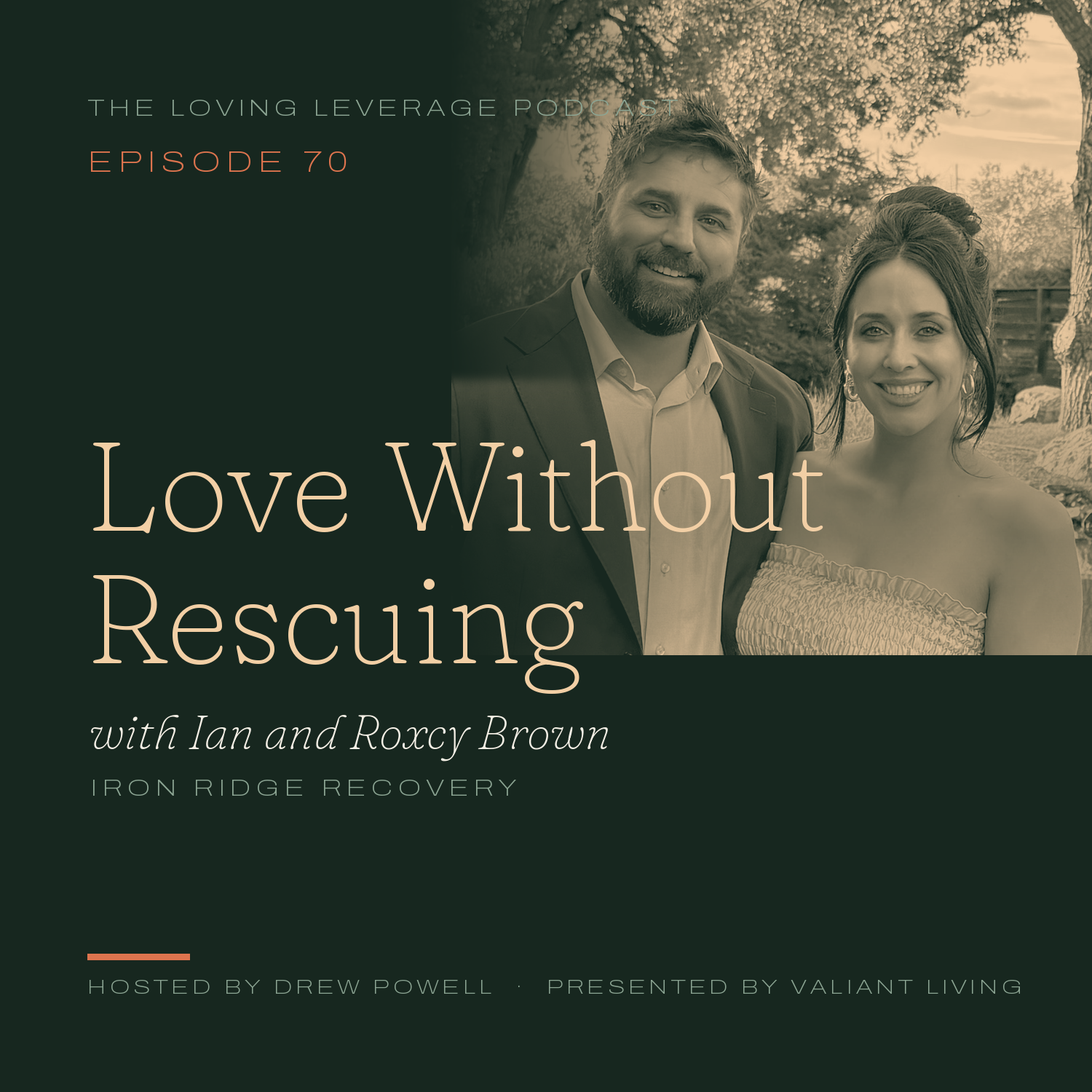
Episode 70 · The Loving Leverage Podcast
Ian and Roxcy Brown of Iron Ridge Recovery on sex addiction as a family crisis, betrayal trauma, and why the most loving move is sometimes to stop cushioning the consequences.
Love can look heroic while it quietly keeps the cycle alive. When someone we love is stuck in addiction, the instinct is to fix, cover, explain, and cushion the consequences. But what if the most loving move is to stop rescuing?
Drew is joined by Ian and Roxcy Brown, co founders of Iron Ridge Recovery in Texas, the first intensive outpatient program in the state built specifically for men with compulsive sexual behavior. Ian leads the men's side. Roxcy directs the partner and family side. Both are in long term recovery themselves, and both have lived this from the inside.
Here's the tension at the center of the conversation. On one side, a man saying, in so many words, I need you to stay so I can be okay. On the other, the person who loves him saying, I need you to change so I can be okay. Both are exhausted. Both are stuck. Ian and Roxcy offer a third path.
Watch the episode
Prefer to listen?
Chapters
Three takeaways
1. Remorse is a feeling. Recovery is a series of actions. After discovery, he probably means every word of the apology. That isn't the question. Roxcy coaches partners to look for evidence and patterns over words, because words don't get anyone from point A to point B. Meetings, therapy, a sponsor, and honest work on what the behavior was medicating do.
2. Her reactions are the most normal thing in the room. After discovery, the partner often looks like the one who's out of control, while the man who just unloaded his secrets feels better than he has in years. An untrained eye reads that backwards. An elevated, unrecognizable response to a profound attachment injury and betrayal trauma is a predictable response, not a problem to be managed.
3. Don't steal his rock bottom. It's natural for a loving family to want to pad the consequences. But a man has to sit in the pit he dug to notice he can't live there. When the family cushions it, treatment never sounds better than the life he has. Removing the cushion isn't cruelty. It's what makes real change possible, and it starts with boundaries that aren't punishment.
This is episode 70. The previous episode was Jeff Hatch on what secrets cost a man. Find every episode of The Loving Leverage Podcast here.
About the guests
Ian and Roxcy Brown are the co founders of Iron Ridge Recovery in Texas, an intensive outpatient program designed specifically for men with compulsive sexual behavior, with a dedicated trauma informed track for betrayed partners. Both have spent years on the business side of substance use treatment and both are in recovery.
Iron Ridge also treats men whose sex addiction runs alongside substance use, what Valiant calls addiction interaction disorder, and both Ian and Roxcy build the family into the work from the start rather than treating it as an afterthought, the same commitment behind Valiant's own family support track.
Drew: Welcome to episode 70 of the Loving Leverage Podcast presented by Valiant Living. I'm Drew Powell, recovery advocate and alumnus of the Valiant Living men's program, and this is a show about what it takes to move from addiction to connection. Today I've got two guests on. It's Ian and Roxcy Brown, co founders of Iron Ridge Recovery in Texas. When we set this one up, they sent over a topic they wanted to dig into, and the title alone stopped me. It's when love stops rescuing. Here's the tension at the center of this conversation. On one side is a man saying, in so many words, I need you to stay so I can be okay. On the other side is the person who loves him saying, I need you to change so I can be okay. Both of them are exhausted, and both of them are stuck. Ian and Roxcy walk us through the family system that keeps the cycle going, the difference between supporting a man's recovery and trying to manage it, why a boundary can be one of the most loving things you'll ever hold, and what actually happens when someone stops protecting a man from the consequences his own choices have created. If you've ever wondered whether stepping back means giving up, this episode is going to give you a different answer. Here's my conversation with Ian and Roxcy Brown.
Drew: When we met the first time, it was at the end of a conference, and I was completely out of words. You're on these trips doing business development, and it's real relational, but I'm going to this dinner thinking I've got nothing left in the tank. And I saw this guy and thought, this guy looks pretty cool. He sits down at the end of the table, so it's just the two of us, and it was the greatest gift ever. Ian, I think you were in a similar boat. It was great to have a friend and not feel like we had to work. This is a guy I'd hang out with in real life.
Ian: I definitely picked a good seat. Down at the other end were all the heavy hitters having heavy conversations about curriculum, and we were just down there chopping it up.
Drew: It was exactly what the doctor ordered. And Roxcy, really nice to meet you as well. I've heard good things and I'm excited for you guys opening up Iron Ridge Recovery. When we first started talking, it was coming up in a few months, and now it's here. By the time this episode releases, you'll probably be open for business. How does that feel hearing it out loud?
Ian: It's been a roller coaster. It's coming fast now and starting to feel more real, but there have been times where it was, man, when will it ever get here? Like with all things, there are unforeseen setbacks and timelines get pushed. Our original date was July or August, and we just had to keep going back. But it's all been happening for a reason. It's been a fun journey.
Drew: As a side note, being a marketing guy, I love your branding. I love your website, I love what you've built. You've got to go check it out. Branding isn't everything, but I geek out on that stuff, and I do think it matters.
Drew: Tell us about it. What you're doing, why you started it. Roxcy, we'll start with you. I read that this is the first intensive outpatient program in Texas designed specifically for men with compulsive sexual behavior. Is that right?
Ian: That's correct. There are places that do it or touch on it, but there's nothing that focuses exclusively on this issue.
Drew: We live in this world, so we're used to it. But when I read that, I thought, that's wild. I'm happy you guys are doing this, because it's such a huge need. So tell me the story behind it. Why now? Why this population?
Roxcy: The broad story is we've been in the world of addiction for a while now. Ian's been on the business side of substance use for seven years. I've always been interested in becoming a therapist. When we first got together I was finishing my bachelor's, and then we moved to Austin so I could go to grad school. I immediately became interested in infidelity because I enjoyed the relational work. I liked having more than one person in the room. And then it became part of my story, where I was introduced to it in a different way, as compulsive sexual behavior. We're both sober. We've been in recovery for a while. I haven't drunk in nine years, which is very exciting for me.
Drew: Congratulations. That's awesome.
Roxcy: So addiction wasn't a foreign concept to us. We worked in it, and then we got the help we needed to walk through this journey. And then Ian came to a point in his career where he said, I want to build something of my own in this space. And I said, what about sex addiction? We know from our experience how hard it was to find the right kind of help and the right kind of treatment. On my end, I essentially had to create my own IOP for myself. Find the right therapist, figure out what kind of group works. I would use AA meetings as places to go and sit and regulate. Give myself a scheduled out kind of recovery and support. I felt really passionate about helping people with this. There are so many treatment centers that help people with such an array of addictions, but there's nothing out here for this. And working in the substance use world, we see it as a co addiction all the time. There are drugs or alcohol, and this. But what's getting treated is only the drugs and alcohol. Honestly, it felt like the whole universe aligned. This feels right. Let's go into this.
Drew: Such a huge need, and you're exactly right. We see it at Valiant all the time. Our guys who come in with substance issues, there's mostly a co occurring sex addiction as well. My buddies who were in for substance would look at the track I was on and say, as soon as I get through this, I need to do that too. There are a lot of similarities across addictions, especially when you get to the thing beneath the thing, but there are nuances, specifically with love addiction and intimacy disorder, that need to be addressed very specifically.
Drew: And you guys talk about this. We tend to see it as one man's secret problem. But what's true, and you call it this, and we'd agree at Valiant, is that it's a family system issue. Talk about what happens to the whole household when addiction moves in. How do the roles reorganize around secrecy, crisis, monitoring? We could probably spend a whole podcast on that alone.
Roxcy: Ian, you want to jump in?
Ian: You're the family systems expert.
Roxcy: That's the part I'm so passionate about. I'm not a CSAT. I'm not going to be working with the addicts. I'm passionate about the partners, the family, the children. And what happens to a family when addiction is present, specifically compulsive sexual behavior, is pretty devastating. At first, they don't even understand what they're a part of. Partners and families will describe this sense of, I know something's wrong, but I don't know what's wrong. I know my loved one is not doing well, but I can't identify what's going on or how to help. And so the family, without fully knowing, starts to morph around the most problematic person. The person who's the most explosive, or, even if their dysfunction is quieter, the one who retreats and goes away. The family system reorganizes around that. With a partner, if it's an explosive person, they're walking on eggshells. They're trying to figure out how to not make things go wrong. They start changing how they behave, maybe abandoning themselves in the process of trying to keep peace in the home or keep the family together. Kids will sense something is wrong, and depending on their developmental stage, they adapt without knowing it's happening. They see the family system is unpredictable. They won't have words for it, but they'll understand what topics to avoid, when the room feels off and it's time to go away, who not to push. Everyone takes on different roles to make that happen. If there are multiple kids, one may become the super appeaser. I'm going to be so good and helpful and make this family healthy, without understanding they're doing that. The system reorganizes to keep safety and peace and connection. Sometimes they're aware of it. Often they're not. They're just responding. When one person is in addiction, it affects the whole system.
Drew: I have so much coming up for me as you share that. In our family, even in recovery, what I'm noticing is that my older children definitely took on different roles when I was in rehab. And it's been an adjustment for us to revert back. We've had to do a lot of therapy with certain kids, saying, hey, we're good, we're stabilized now. We don't need you to be the adult in the family. When both parents are going through crisis, especially if you've got older teenagers or adult children still in the home seeing it firsthand, depending on that child's personality, they can rise up and take on the strong adult role. We've had to relieve that pressure. We had a therapy session where the therapist drew a line on the board and talked about going above the line and beneath the line. He said, you can go back below the line now. Mom and dad are good. On one hand it's beautiful. It's a great survival skill. It was amazing that we had kids who stepped into that strength role. But they're kids. It was never their job. It's unfair to ask them to do it. And then to relieve them of their duties isn't easy either. That's their defense mechanism.
Roxcy: It's how they learned to survive in the chaos when it existed. So when the family stabilizes and recovery is entered, it's, oh, you want me to not do my protective role? That's how I feel like the family stays sane. Things are going to blow up. That's usually when you need a therapist to come in and help draw that line. While it's beautiful that kids can adapt in those moments, you do want to relieve them of that role. Go back to being the child. We've got it.
Drew: And everyone's timeline is different. As we were doing impact letters and the amends process, some kids dealt with stuff early on. For others, it was two or three years later that things came up. They weren't quite ready then, or they were still holding onto whatever felt safe. We talk about the family system as one unit, but there are many parts within that system, and each part needs its own individual care. You don't work amends for the whole system the same way. Different people need different things.
Roxcy: Your wife's timeline is different from each kid's. It's a very complicated system for everyone.
Ian: And for the addict in that space, they're in full fight or flight. They have such a distorted perception of reality. They don't even know what's real and what isn't, or how they've caused all this. Usually at that point they're still pointing fingers. Why can't you just act normal? It's the definition of dysfunction and chaos.
Drew: Talk about that for a minute, because I relate to that side. A lot of us addicts, when we're in crisis, and I'll speak for myself, I had such high control. I almost have to laugh at myself looking back, because I was still thinking, I can figure my way out of this. If I could just talk to my kids, if I could just talk to my wife, I can fix it. Everything I thought was rational was exactly upside down. Everything I thought would help would hurt, and everything I thought was going to be bad for me was what I needed. It was insane.
Ian: That's where the disease model really fits. This centers in our brain and in the way we think, and our thinking is not going to get us out of this. The delusion and self deception that has to be happening when you're in that active addiction cycle is real.
Drew: We talk to guys all the time, and I'm sure you do too, where it's so hard to get through to them. They're so convinced of what they believe is the right thing to do next. I can't lose my job. They're holding on so tight. That's why we call the podcast Loving Leverage now. We changed the name and brand. The reason is that most of these guys, if they don't have some sort of loving leverage in their life to get well, they're not going to think themselves into healing. I'd imagine guys aren't showing up at Iron Ridge saying, hey, I'm a sex addict and I'm here to check myself in. Usually there's some sort of crisis and someone saying, you're going to do this, or I'm out. So talk about the addiction cycle and how we get through to these addicts who are holding on so tightly to what feels safe.
Ian: I think it's okay for them to come in with that fear of losing things. The job, the career, the money, the wife, the family. That's okay to get them in the door. But it's not going to create lasting change. When we talk about the addiction cycle, it's a longer cycle than just the acting out. It's the preoccupation, the ritualization, the acting out, and then the guilt and shame, and it repeats. It takes a level of awareness of what's going on. What are the attachment wounds or core beliefs driving you to start the process before you ever get to the acting out? Because there's usually such a high level of delusion that they can't see themselves. They don't know what's driving the bus. So they also don't know when the cycle starts. They think it's just the behavior. And if we're not getting to what the behavior is actually doing for them, we can't change it.
Drew: Let me go back through what you said, because I think it's so good. Preoccupation, ritual, acting out, the crash into shame and despair, and repeat. Can we go a layer deeper into what's underneath it?
Ian: With the preoccupation, that's where it starts. The seed's been planted. That's all your thoughts are. It can be anything from objectifying women to obsessing over the idea of doing it. The ritualization is whether that's cruising around areas you shouldn't be in, looking for places where escorts are found, or cruising different websites. The acting out is the actual sexual behavior. And then inevitably afterwards you're struck with the guilt and shame of what you just did. The guilt and shame is really the driver of the whole cycle. It's a perpetual cycle you're stuck in. Even after discovery, or after you're caught and the consequences happen, you can feel sorry. You can feel real remorse. But unless you understand what's driving the bus, and what the acting out is actually doing for you, whether that's numbing, looking for validation, looking for relief, your chance of recovery is not good.
Drew: I like to refer to these things people treat as actually the medication. If you're not careful, you're medicating the medication, which sounds ridiculous, but everyone's medicating something. If we don't get to what they're actually medicating, we're never going to wean them off. Roxcy, I'm sure you see this constantly in the work you do, helping people get beneath that. So when it comes to the shame phase, which produces the remorse, why do remorse and promises alone never add up to recovery? Because sometimes the guilt and shame set in and there's genuine remorse. I'm so sorry, I promise I'll never do this again. Little do they know there's no way, as long as they're in the cycle and still medicating, that they'll be able to hold to that promise.
Roxcy: In those moments, whether it's partial discovery or the whole discovery, there's a crisis moment in the partnership where the person is pleading for forgiveness and making promises. And like you said, they probably truly mean it. They probably truly are sorry. The reality of the situation is that remorse is simply a feeling. It's stating that you feel a certain way. And while it can be perceived as a safety factor, oh, they feel bad, I believe they won't do this again, and even the addict believes it, that's just stating a feeling. Unless it's followed by some sort of intervention, treatment, meetings, therapy, something to address what this medication is doing for them, it's not going anywhere. Recovery is a series of consistent steps. Going to your meetings, calling your sponsor, going to therapy, understanding yourself and breaking down the mental walls you built to be able to do the things you did.
Roxcy: Without action following remorse, it's just a feeling. That's why a lot of the work with partners is getting them, not to stop believing in their partner, but to look for evidence and patterns over words. The words, while they may be impactful, aren't going to get us from point A to point B. Just like any addiction, the meth addict can be so over the consequences and still pick up the needle. It's about action.
Drew: What comes up for me is that it makes sense when you break it down. At some point the pain or trauma we're medicating is going to come back. And in order to feel okay and survive it, we're going to have to use the medicine again. Sometimes it's a different medicine. We get guys who come through for one thing and come back for another. If you don't treat the actual symptom, it's unfair to ask yourself not to medicate it. What you do at Iron Ridge is help with, how do we deal with the symptom, the pain, the trauma, so you don't have to run to the medication? It's about being kind to yourself as the addict.
Ian: I love the medicine language. What is the medicine doing? Is it attachment wounds? Is it a core operating belief you've held your entire life that's driving these behaviors? Because as addicts, it's really easy to get things back to normal. We're so sorry, we're never going to do that again, swear on the Bible, whatever. And life can get normal. If your entire motivation for recovery was for the chaos to stop, and you don't know what the medicine was medicating, you're going to turn back to it, whether in a cross addiction or the same behaviors.
Drew: A lot of the work you do, and we do at Valiant, is helping people reframe and approach this whole thing differently than what most of us grew up with.
Drew: There's so much shame specifically around sex addiction. Let's talk about that, because that's the world you're going into. It's easy to slip into sickness versus moral failure. In the world I came from, the church world, we love to call pastors moral failures. That's not untrue, but it's not specific to them. It's a human thing, and it's less a moral failure and more a disease. A lot of the work is reframing: you're not a terrible, gross, disgusting person. You're a sick person who needs healing and found something that gives you temporary relief. How do you do that work, especially as people first come in with so much shame and stigma?
Roxcy: There's so much stigma. We've come so far with addiction. We can talk about alcohol and drug addiction more freely. But there's still historically a stigma. And then infidelity and sexual addiction is another stigma. So sex addiction is this monster of a stigma. People come in on both ends, the partner and the addict, with so much shame that this is their story. Ian Birdwell, our clinical director, one of the things I really like about his approach is that we're not coming in aggressively. Get honest, tell us what you've done. The first thing is to orient you to your reality. What has this cost you? This coping mechanism you developed and kept in secret, what did it cost you to get here? Really taking a look at the damage to yourself. It's hard to get honest when there's so much shame. For partners of sexual addicts, there's this idea of carried shame. Michelle Mays in The Betrayal Bind talks about it. We're carrying shame that's not really ours, for actions we had no control over and didn't know were happening. So a piece of the partner work is separating what's theirs and what's not theirs. Then there's the psychoeducation piece. This is sexual addiction. We see different responses. If they're already introduced to the addiction world, they can wrap their head around neural pathways, dopamine seeking, chosen coping strategies. If they have no addiction past and it feels like their partner has morally failed, sometimes there's pushback on the addiction model. Well, then we're giving them an excuse. To label this as addiction is not to excuse the behavior. The behaviors were not acceptable. To understand it as addiction does lessen the shame, but it's not to write it away. It's to view it as a disease. This is a brain seeking relief in its frozen ways.
Drew: I'm so glad you brought that up. For betrayed partners, one thing we hear a lot is, we are not excusing this. From the addict side there has to be complete ownership. Sometimes people hear, well, it's a disease, and it's like we're letting them off the hook. For my wife, it was actually a relief, because there was some understanding around the why. For others, it's, oh, real convenient, call it a disease, now he's the victim. That can be really tough. I'm so happy you're making this a huge emphasis, because a lot of the time in the sex addiction world, it can be all about the addict. And you've got this traumatized partner who doesn't have the same resources, dealing with real time stuff, and then some people come at her and say, well, you're just as sick, you're codependent. That may be true, but what she needs immediately is care and healing.
Drew: For betrayed partners it almost feels like you're damned if you do, damned if you don't. If I stay, I'm weak and a pushover. In some circles, if I leave, I should have been more loyal. They get stuck in this middle ground of shame on both sides. How do you help them? Because it's a decision a lot of people are trying to make. Do I stay, or do I go and start fresh?
Roxcy: I've talked to a few people and we joke that the decision is between two piles of crap. Neither is great at the moment. Choose your hard. The partners are in crisis. And historically this industry really helps the addicts, and the betrayed partners are left with their trauma, usually untreated, almost flailing. Maybe they're home with the kids, they're the ones still making the money, they've picked up everything the addict had to drop to go get treatment. I heard this joke: the betrayer has essentially shot his partner. An ambulance comes, picks up the shooter, runs over the person who's been shot, and drives away to go help the betrayer. And you're sitting there like, what just happened? And then it gets worse, especially historically, when it was viewed as co addiction. After discovery, the partner whose world has been turned upside down appears more out of control, more emotional. And the untrained eye will look at these two people and say, oh, that's the problem.
Drew: And the addict is all put together. I've got this. I'm in control.
Roxcy: Or they're relieved. Their secret's out. The weight is off their shoulders.
Drew: They just vomited all over everybody and feel better.
Roxcy: They're feeling better than ever, and the partner is over there losing her mind. There haven't been a lot of great treatment options. It's getting so much better, but you have to seek a trained professional. I've talked to a lot of partners who've been traumatized by clinicians who don't mean to, but come from a different model that doesn't apply to sex addiction. There's victim blaming and mental confusion. Finding the right therapist, APSATS trained, someone who understands betrayal trauma, is so important. What I like to tell them is that the most normal thing happening in this entire scenario is your crazy responses. You responding in these elevated ways, in ways that are uncomfortable for other people to see and for you to experience, where you don't recognize yourself, is a completely understandable and predictable response to a profound attachment trauma. It makes complete sense.
Drew: It makes total sense. And Ian, I'm glad you mentioned that this is why you can't navigate this alone without good professionals. I know it sounds self serving because we're in the space, but there's so much going on at the same time. Roxcy just explained what's going on in the betrayed partner's mind. What's also happening in the addict's mind is that this is like a fatal disease, but instead of getting sympathy for it, I've hurt all the people who would normally rally around me. It's a disease that happened to all the people around you. So if you're going to get support, it's usually from strangers, because the people who love you most are the ones you hurt. That's also why you need professionals, because it feels really lonely and isolating.
Ian: That's one of the things that drove us to Iron Ridge. The relational harm is so great in sex addiction, and it affects the entire family system. We do a disservice when we treat the partner or family side as an afterthought and not its own treatment. The addict goes and gets better somewhere for 30, 45, 60, 90 days. He has all this awareness and he's feeling good, and he gets put back into the family system. And the family system's recovery is just now starting. What's inevitably going to happen is dysregulation hits, the partner or family lashes out, and to a sex addict who usually has some type of attachment wound, he's hearing, you don't love me, you hate me, instead of, you're mad. Our perception of reality is so skewed toward selfish motives that it drives the shame. And the shame is the driver of the whole cycle.
Drew: I want to talk about discovery and the word opportunity. The opportunity that exists around discovery for real help and healing, and the importance of leaning in, of leveraging that moment. It's a critical moment in the story of a couple or family. Roxcy, you said the betrayed partner is extremely traumatized, but she's also being asked to set boundaries and it feels like a lot. How do you walk couples through discovery, and the consequences versus protecting?
Roxcy: I keep relating it back to drug and alcohol addiction, because we have so much experience there. We coach parents, and probably partners too, when their kid goes into rehab or someone's addiction comes to light. It's a natural response of a loving family system to want to help the person who is unwell, to pad the consequences. You see a problem, you're good at solving problems, I can help here. One of the things I coach people around is, don't do that. There's this idea of, don't steal someone's rock bottom. Someone has to be in the pit they dug themselves to notice, I can't live like this. This is really bad. And even though recovery or treatment doesn't sound that appealing, it's going to sound a little better than how bad my life has gotten. They have to feel the consequences of their actions to be motivated to change. It really is an opportunity. It's a place where someone can use that pain to drive something better. But if a family or partner comes in and makes it better, cushions the consequences, makes it all about the addict feeling better, often the addict isn't aware of how bad it is. This is not great, but it's not horrible.
Drew: Ian, from your perspective, why is it so important to remove that cushion? That's really the heart of where we're driving in this episode. Why is that what makes genuine change even possible?
Ian: Usually as addicts, we have to feel real consequences to make life as it is unsustainable. That's what drives change. We talk about pain as the touch point of growth. If you're continuously cushioning and hiding things, and the family system is trying to stop him from hitting that bottom, you're robbing him of the pain he needs to actually change.
Drew: So true. We're going to have to have more conversations, because we're barely scratching the surface.
Drew: I want to drill down on your program. Roxcy, practically, what are you going to be offering? You're directing the partner and family side. What will that look like?
Roxcy: I have so many dreams for it. I picture this going very big. But where we're starting, we're very much using a trauma model. What you're experiencing is an attachment injury. You're responding to trauma. So we treat it as trauma, walking through the trauma, and there's also the psychoeducation piece. In the APSATS model there are three stages. Partners are typically coming in after a discovery, their partner is seeking a higher level of care, or he's coming down from a higher level of care and coming home for the first time. Either way, they're in phase one. Their world is still rocked. So a big focus in the beginning is safety and stabilization. We are not going to focus on the addict. We're not here to discuss in detail his behaviors right now. Our main focus is your stabilization, safety, happiness, and values. It's a lot of nervous system work, grounding, connecting with your values again, separating your shame from his shame. I don't encourage decision making about the rest of their life in this stage. When your head is on the ground and you're in pieces, you're not going to make a decision from a values based place. Sometimes it's helping people pause. You don't have to know what you're doing yet. Right now you're gathering enough information to make an informed decision that's for you. What's offered is weekly individual therapy and group therapy. Group does really well with this population because people feel so alone and so shameful. To be near other people with a similar story is really important. So for partners, it's two to three hours a week of therapeutic support to start. My goals are much bigger than that.
Drew: And Ian, a man's motivation is often in three stages as well. Early recovery, deeper recovery, mature recovery. How do you plan on working with that population?
Ian: Like we said, the fear of the consequence opening the door into recovery is fine, but it can't stay there. Your recovery is still dependent on an outcome you cannot control. If she stays, I'll change. It's the same thing when we talk about compliance versus recovery. If you have a checklist and you're going through it in a performative manner, look how great I am, I went to a meeting, but you're not actually looking at your identity. With these men who come in, they have three versions of themselves. The fear of who they could be, the man they are, and who they want to be. The work is aligning and integrating those. There's so much shame and guilt driving the behaviors, and shame and guilt in the behaviors themselves. Making sure they don't have a shame based personality, where they can say, I have done bad things, that doesn't make me a bad person. Because if you live in, I'm just a bad person, you're going to continue to have bad behaviors and continue the cycle. That's why it's so important that at Iron Ridge you're with guys who have similar issues. The core drivers, the attachment wounds, might look different, but the acting out is the same. That opens up real, authentic conversations to get past the shame and guilt. I'm not in this alone. There are other people who've gone through this.
Drew: I'm glad you touched on the performative side, because that was my story. I was going to be the best client who ever went to Valiant, ace this thing, and get out on good behavior by checking all the boxes. The truth is that's not where the real work happens. If I was smarter, if I wanted to get through the program faster, I would have surrendered earlier. That's the key to transformational work. You just let go. You can do all the therapy, go to Valiant for 90 days, leave and go to Iron Ridge, check all those boxes. But until you're ready to surrender and let yourself be fully immersed in this process of healing and change, that's why we see people relapse. You can't perform your way through it. Aspirationally, paint a picture. What does it look like for couples who make the shift? Where it's, I don't have to codependently manage your recovery. I can be okay even if you're not okay.
Ian: At the beginning we talked about what the dysfunction looks like. For a family in recovery, on the addict side you have a man who's not just going through checklists, not doing things for an outcome outside himself. He's doing it because it's integrated into his identity. He's moved from, if I do this, will she not leave me? To, who is the man I want to be? Am I fully integrated in who I am when I walk outside these doors and my wife isn't next to me? Am I having conversations with people that I'd have in front of my wife? On the betrayed partner and family side, it's making boundaries and using love as leverage, but not as a punishment, because they're fully defined in who they are and where they stop. They're choosing to be there, but they're not going to be a part of the problem, and they make that clear.
Drew: That's right on.
Drew: I like to close episodes with this question. For the man listening in the car right now who feels like his story is already written, or the person who loves him who's running out of hope or feels like they've tried everything, what would you want them to hear?
Ian: You want to go first, Rox?
Roxcy: For that man, hope is not lost. Get into action. Get into action. That's the best thing you can do for your family, for yourself, for your children. Be brave in your actions.
Ian: And for me: you're not alone. There is help out there. As scary as it is to pick up the phone and call, it's the best gift you can give yourself, your family, your friends, your loved ones. Just like the addiction started with small changes in behavior, you can walk your way out of the woods. There are people here to help.
Drew: That's Ian and Roxcy Brown, and you can learn more about their work at Iron Ridge Recovery. I'll put the link in the show notes. What Ian and Roxcy described today is the heart of the Loving Leverage framework created by our founder, Michael Dinneen. Love stays close without rescuing. Two people taking ownership of their own recovery instead of trying to control each other. If you're living inside that tension right now, head to valiantliving.com to learn more. Or if you're ready to talk with someone today, call us at 720-669-1285. That's the admissions line for our men's program, and a real person picks up when you call. The show notes and links for today's episode are at valiantliving.com/episode70. If this episode helped you, please share it with the man who needs to hear it, or with the person who loves him. And subscribe so you don't miss what's coming next. I'm Drew Powell. You've been listening to the Loving Leverage Podcast. We'll see you next time.
Get help
What Ian and Roxcy describe is the heart of the Loving Leverage framework created by our founder, Michael Dinneen: love that stays close without rescuing. Two people taking ownership of their own recovery instead of trying to control each other.
If you or someone you love is struggling with addiction, you don't have to face it alone. Valiant Living helps men ages 26 and older, and their families, move from crisis to stability through clinically driven care, community, and hope.