
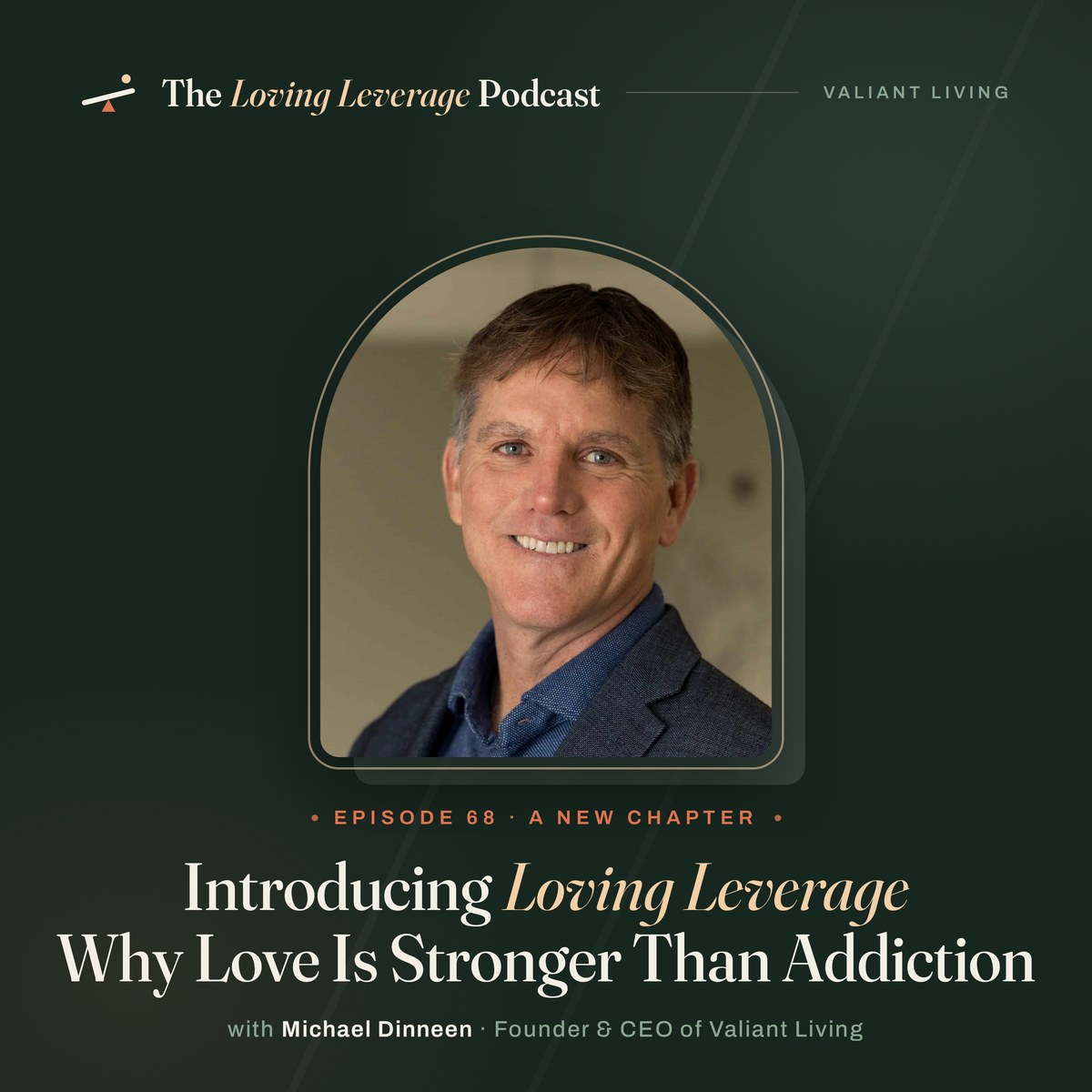
The Loving Leverage Podcast · Episode 68
Watch the episode
Prefer to listen?
A new name, same mission
The Valiant Living Podcast has a new name. Welcome to the Loving Leverage Podcast.
We renamed the show around a phrase our founder Michael Dinneen coined: Loving Leverage™. It names something true in every recovery story. At some point, love became the leverage that made healing possible. Sometimes it was a spouse holding a boundary. Sometimes it was a parent who refused to look away. Sometimes it was the moment a man finally chose to love his kids, his family, or himself more than the addiction.
In this first episode of the new chapter, host Drew Powell sits down with Michael to unpack the idea behind the name and what it means for the families we serve.
Michael shares the story of his own rock bottom in 1991 and the phone call that saved his life. Together, Drew and Michael talk about why spouses and parents hold more positive power than they realize, how to hold boundaries that break the cycle of negotiation and manipulation, why the label of codependent often misses the deeper reality of trauma, and what the gift of desperation really means.
If you love someone who is struggling with addiction, this conversation will help you understand the addiction cycle, why no one can fight it alone, and how a team of people who love you becomes the leverage that leads to healing.
Chapters
Aligned to the YouTube video, which has no intro or outro. The Buzzsprout audio includes Drew's welcome and runs 2:11 ahead.
"I'm not hard on the addict. I'm hard on the addiction. I go after the addiction, and I know how to fight addiction."
Michael Dinneen · Founder and CEO, Valiant Living
About the guest
Founder and CEO · Valiant Living
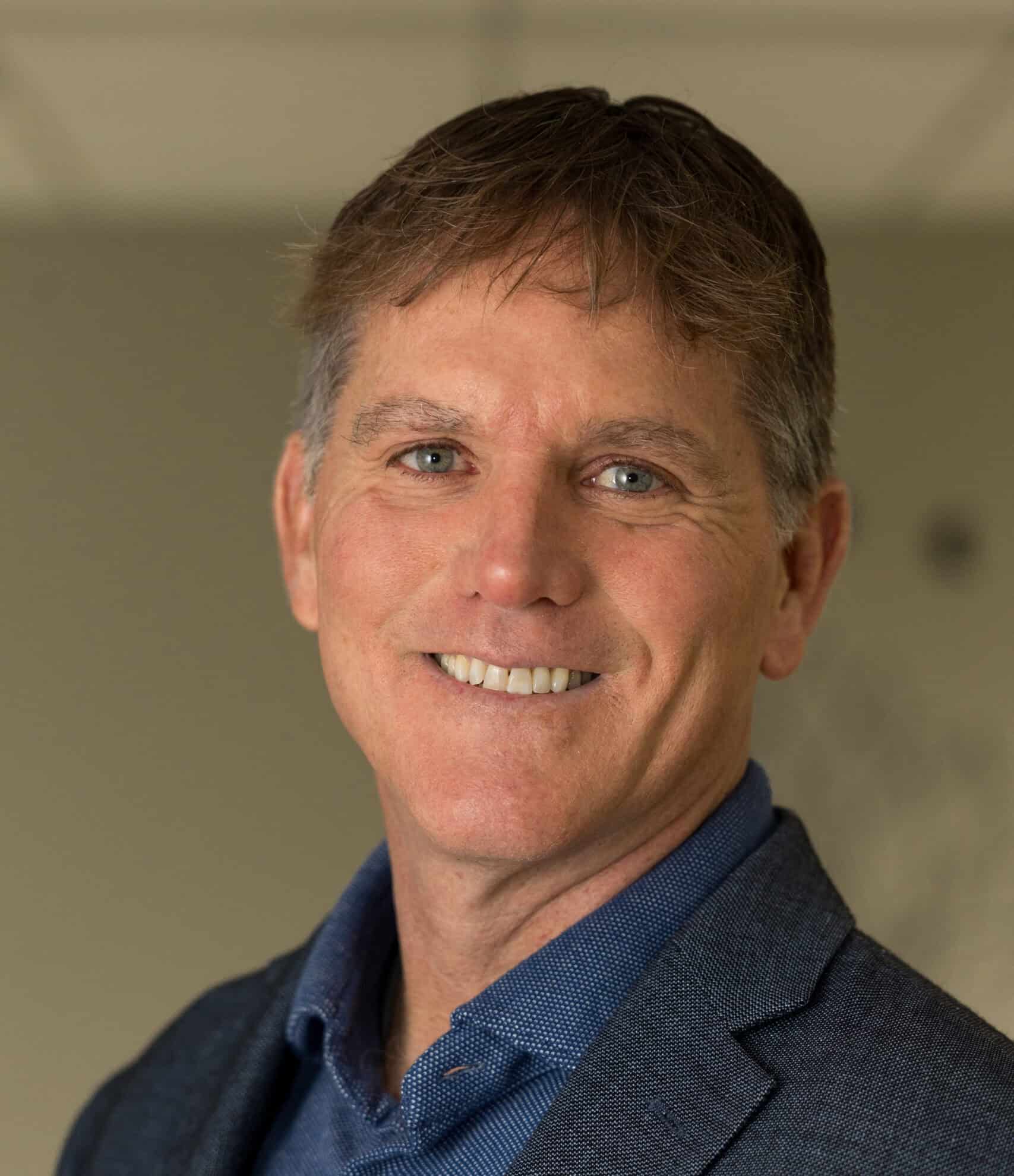
Michael Dinneen, LCSW, CSAT-S, is the founder and CEO of Valiant Living and the creator of the Loving Leverage™ framework. In recovery himself since 1991, Michael has spent more than three decades walking with men and families through addiction, trauma, and healing. He built Valiant Living on a simple conviction: the only thing stronger than addiction is love, and families who learn to use that love well can change the direction of a man's life.
For therapists and treatment professionals
If you are a CSAT, therapist, or treatment professional and want to know if Valiant Living is the right fit for your client, Drew would love to have a personal conversation with you.
Set Up a ConsultationDrew: Well, hey everyone. Welcome to the new and improved rebranded Valiant Living podcast that is now known as the Loving Leverage Podcast. We changed the name of the podcast because we really wanted to focus on this phrase that our owner and founder, Michael Dinneen, came up with. And it's this idea of loving leverage that at some point in all of our stories, love was the thing that motivated us to get healthy and get well more than the addiction itself. So whether you're a betrayed partner and you're holding boundaries, you're like, these boundaries are the loving leverage I'm using to help my partner get well. Or maybe it's even the addicts themselves. It's like, listen, I'm choosing to love myself. I'm choosing to love maybe it's my my kids, maybe it's family, maybe it's something else. I'm going to choose love over this addiction. And we believe that that is more powerful. And oftentimes it's someone else's love that's the leverage to get us through. And so we're excited for this new season, this new chapter of the podcast. And today we're joined by Michael Dinneen himself just to kind of unpack more of this idea of loving leverage. And so I love it when Michael shares and when he teaches. And we're gonna we're gonna pop in from time to time. Michael and I meet every Monday, and half the time when we meet on Mondays, we just go down these tangents and rabbit holes, and we talk about recovery and addiction. And so I just start to hit record on some of these conversations when we meet. And so every once in a while I'm just gonna drop into the feed just of kind of just like moments and you know motivation with Michael. I don't know what we'll call we'll come up with something clever, but just so you can hear more of his heart behind our program and what we do. So with that said, we're gonna jump into today's podcast. Before we do, I want to let you know if you are a CSAT, a therapist, if you own a treatment center, if you're in the industry and you want to you want to know if Valiant is the right place for one of your clients, I'd love to personally have a conversation with you. You can go to Valiantliving.com slash consult and we'll set up a time for consultation. I'll tell you more about our program and see if it's a good fit for you. So it's Valiantliving.com slash consult and we'll set up a time to talk. All right, we'll jump in with Michael. I love this direction you've been leading us because I would want the the guys like me to hear this is this loving leverage is for them. This is not us like we're gonna we're gonna side with you know the spouse, whatever. Like honestly, we want the guys to get to the point where they find the loving leverage within themselves eventually to get the help they need. The truth is, at least in my case, I didn't have that yet. I needed my my wife and kids, everyone else to find love because you know, we we believe that the only thing stronger than addiction is the is love. like a true love is a thing that motivates us towards change. So I'm curious why, as even an organization, it's not really a pivot. This has always been true, but we're just getting way more intentional about it. Why have we started to really serve the spouses and the parents and the kids and with this loving leverage concept?
Michael: Yeah. Wow. Excellent. And I I love this idea too, about sh even even releasing some of these videos to the clients so they can see the the the they can see the reasoning behind it and yeah, and then in some respects lose lose any resentment against the family and against and some against Valiant over why why we do what we do.
Drew: Well, totally, because over time people I'll just speak for myself. I am so grateful for the people that made me do, I say made me, I had a choice, but drew the boundaries, which is I think your your term of loving leverage is just a better way of saying ultimatum. They just said hey, this is what you have to do. I never would have done it for myself and was even angry, but four years later, I'm like that's the people that saved my life. And so that's what I want people to look back and say, like, hey, this wasn't like no one was against me, everyone was for me. I just my brain wasn't online, I wasn't thinking straight.
Michael: Yeah, yeah. Well, let's do you want to jump? Want to jump. Yeah, we're going. We're already going.
Drew: We're in it.
Michael: Sweet. Let me dial it all the way back to the moment after the moment. So like I hit I hit a bottom, and again, like we never want to superimpose necessarily our our own path and our experience and what's happened to us. It's been a big problem with religion and recovery, and one guy gets a little help from trauma work and or breath work, or some guy gets it gets into a cold plunge and all of a sudden he his anxiety goes away. It's like everybody has has like multiple methods and and there there is no there is no like there is no miracle deal here. The only miracle happening is when is when this this psychic change happens inside of somebody's soul and inside their their body and their spirit. And but but we'll we'll do the best we can, you and I, to to weave in our experiences with the field, with friends, with family, with ourselves, and and and and have a dialogue so that we can start supporting people that are that are in it. so for me it was like I've I've told you that story a bunch, but I was I I had the gift of desperation. it's it in the AA big book, it talks about how rare those experiences are, those white light, road to Damascus, Burning Bush experiences, that they they almost over-emphasized those at the beginning of the recovery movement back in the 1930s and 40s. They they talked about so many of these experiences that people started thinking that they had to have those too, these great upheavals. And what they and that's why in the appendix, it talks about it talks about a spiritual awakening sometimes is of the educational variety, that it comes through a it comes to a lot of different things. And then and you look back and all of a sudden you're like, oh my gosh, what happened in three months couldn't have happened in 30 years unless there was divine synchronicity and a whole bunch of things happening all at once. so so when I when I talk about my experience, it was it was profound in the sense that I was in a Jeep on Route 9 on August 5th, 1991, and I had a complete meltdown, an interior meltdown where I didn't care if I lived or died, and I was willing to do anything to get out from the pain that I was in, but also to make amends for all these people that I had hurt. My my my mother, everybody that came in touch with me got hurt in some way, shape, or form. And I had a deep realization that and this isn't even negative, but the deep realization was I'm a problem on this on this planet. Like there isn't a person that touches my life that doesn't get affected neck in a negative way. And having that realization and then having that kind of mental breakdown put me in a position where I had the gift of desperation. I said a prayer that changed my life, which is basically that classic help. Just help me. Like I got no answers. I nothing. I've got, I can't decide I'm gonna whatever, grow my own weed and move to a farm in Vermont. Like I can't, I've got not one possible answer to my dilemma, which is me. And and that's what that's where the ego deflation, and that's where I was open, that's where I surrendered, that's where I had that experience. That's when I call my sister up crying. But this is key. This is before cell phones, but I call my sister, and she doesn't know what to do other than to say, Michael, I'm sorry I can't help you, but here's a number call. And she started crying and she hung up. And that was one of the hardest things she's ever had to do in her life was leave her brother on a phone call, crying and saying, There's nothing I could do for you anymore, Michael, but I think these people might be able to help you. And I was just desperate enough to make the phone call. So I think that I think it starts we don't realize that two weeks before she was in a graduate school class, and and some teacher said, if you ever really want to help somebody that's suffering from addiction, here's kind of what you do. And she followed his instructions. and so do you see how like in some ways it's there's a lot of there's a lot of synchronicity involved in in that phone call.
Drew: Oh, for sure. And and I've heard you talk to so many spouses, and in our case, because we work with men, so they're mostly mostly women that we're talking to that have to and I've I've heard you with just so much empathy because that feels almost impossible to do when you're in this relationship that for for many people they've been in for so long. And this letting go, because I you know, the the people that we talk to the most, I would say, are spouses who are saying, Hey, I I I wish my husband would go to Valiant. I I wish they would go and get help and get the treatment, and they just they feel almost stuck or helpless in knowing how to make that handoff or even how to detach themselves from you know, it's it's tough. It's it blows up their whole framework for living. How do you help navigate those conversations? Because that's that's some of the most tender moments of a person's life.
Michael: Yeah. Well, I thank you. Well, I come I come in with a lot of compassion for them, especially like a wife or parents, and they're they're they're feeling guilty about a whole I I go in with the assumption that they're feeling guilty deep down, as mad as they are. Part of the anger is that they're mad at themselves of like, how did I let it get this far? Or the the addiction has split the parental marriage. One one the mother is softer and the dad's harder core, or vice versa. Somebody wants to play hardball, the other person is is suffering from a little bit more of the enabling behavior. so I'm going in knowing that I'm so I'm going in assuming that this woman, this wife, is holding so much pain. She's trying to hold the family together. She's thinking about the kids and the impact on the kids. She's feeling like a fool because she's because she feels like she's being taken advantage of and gaslit and not heard and not respected. But she also cares and and deep down loves them. There's a reason why she married him. And so she's so she's confused. She doesn't know. There's all these people saying, well, you can't do anything until he hits his bottom and actually wants help, and you're never going to be able to get to him unless it's him that decides. So you're getting all this conflicting information. You're getting the girlfriends or the church group that are like, I wouldn't put up with that, I would leave him, and because they're bringing in their own trauma. And so I'm going in wanting her to know that she did the best she could, which is amazing, and that she's suffering from trauma, so that she doesn't feel like she's getting labeled as the codependent wife or the enabling wife or the angry wife or the controlling wife.
Drew: I haven't even heard you say you stopped using that, those terms because a lot of people going, oh, you're codependent. And you're like, I've heard you tell people, no, like, okay, maybe we'll get to that later. You're traumatized, is what you are.
Michael: By the way, you know, we're all codependent. Right. We are all codependent in the sense that we take as as humans, we have so many masks. We take, we take on personas or we we act certain ways in order to to to to to better position ourselves to be loved by others or admired by others or whatever. And and we don't even know we're doing it. Most of our lives is lived on an unconscious basis. So codependency, just yeah, assume that we all have it, but we don't need to bring it up on a phone call with a woman.
Drew: In the most painful moment of her life to be like, well, you're codependent. Like, well, okay, but you're also dealing with deep trauma.
Michael: Right, totally, totally. And and so I I I hope to go in, but I also want to keep them, I want them to feel empowered and strong when I'm talking to them too. So like I I let I want to let them know. I think you brought this up last week or the week before that you oh, you said it on something that I saw on LinkedIn where you were like, you have more, you have more positive power than than you than you've ever realized, right? So I want them to know at the end of that that even though it's true, you didn't cause it, you can't control it, you know, all of that, all of that's true. And there are certain things that we can do that can help the process, and there's certain things that we can do that can that can extend the process and delay the process of getting well, right? And and so we can we can look through that lens and start to empower the family, the people, the older, the older children, right? Maybe it's an elderly parent, that we can start empowering them to understand what real love and compassion feels like, and it and it doesn't always feel good. It's not it's it can't be about how they react to us, how the suffering addict who is in a savage place of don't take my air from me, don't try to control me, don't try to, because in the back of their heads, their their behaviors are keeping them alive and and and it's it's part of who they are. And so they're they're coming from a very, whether they know it or not, very defensive stance. They're either going to try to disarm the person by agreeing with them, or they're gonna come at the other person very hard. But in no cases are they a logical human being just receiving information and concern from those around them and said, Oh, yeah, honey, I've heard you talk about this that you're concerned about my behaviors. I appreciate that. Let's talk more about that. And what I'm curious, what did you mean by by that when you said you're scared of me and my behaviors? Like, like it's it's always an how do I outmaneuver this woman situation, right? Without even knowing it.
Drew: Totally. I mean, so spot on. I mean, you're it's kind of like I mean, not to make light of it, but it's like negotiating with a terrorist. I mean, you're just not gonna the the gaslighting, the manipulation is so deep that you you're just not gonna get anywhere. I mean, it's just not gonna get anywhere.
Michael: And the and here's where I want these what these men to know is we're trying to save them from their like their wife is probably reading some book going, oh my gosh, he's a total narcissist. And then and this book is saying, get out, get out fast, get out forever, because there's nothing you can do. So, like, we're actually trying to save this guy from himself that an illness resides inside his brain that's actively lying to him. He's he's he's gas-lit himself. He has narratives about everybody and everything. They say alcoholics are the only people that can lay in the gutter and judge the people walking by. We act like we're not judgy, but we're we're literally judging everyone and everything, including ourselves. And we have a boatload of shame that we're trying to fight against and pride. So we have all this, these things working in ourselves. We have the Lord of the Rings trilogy playing itself out inside of us, and and so, and we're trying to outmaneuver everybody that's coming at us, right? So, so that's that's the thing that I'm trying to tell these guys is like, we're we're not, we're actually not against you. We're actually against the illness that you don't even that we could strap you up to a lot lie detector test, and you would pass it. You would look us in the eye and say, I think she should she should stop trying to control me so much. And I've just had a rough year, and if I had a little bit better business and I started doing triathlons again, I'd be okay. And they would pass the lie detector test. So they don't they don't see it, they don't see this debilitating that's gonna crush their relationships with their kids, themselves, God, and others, that that they're gonna continue to go inward and they're gonna become self-centered and selfish. And and when you've got that quality, it's like bo. It's like being on a plane and smelling some dude next to you, and you're like, This guy's got oh my gosh, this guy's got bo. He doesn't know it. It's so true. He does not know it.
Drew: So you don't smell it?
Michael: You can't see how this is all about you, and you're like, what? Me going to work every day and and and and working hard for this family? You're just saying that that's all about me, yeah.
Drew: and yeah, that's hilarious. That's so that's a perfect example. That's so true. So, what do you say to the so what do you say to them then? Like, is it more about what your sister did? Is it stop with the negotiation and make a handoff to someone who can help? Or like, is it not that easy? I mean, how because I see people stuck in this cycle all the time, they're negotiating, going back and forth, and kicks him out of the house and he's on the couch, but then he talks his way back in, and it just goes months and years sometimes in this cycle. How do you break that cycle?
Michael: Yeah. Well, even in myself, it's like I have so many examples. I remember I was so codependent with the kids because I didn't want them to feel shame. And I would I would get so uncomfortable when they would get upset. And and you know, my kids, they both have strong personalities, but they figured me out like within seconds. Like if I would say, Caden, you are in trouble, go to your room. He would, he would get really upset, he might cry, he'd flop around the floor, and then I would find myself feeding him corn chips and water and rubbing his back and consoling him for what he did.
Drew: Right. I'm only laughing because I do the same thing.
Michael: Because I was uncomfortable with that he was upset.
Drew: Right.
Michael: Right. So, so, so what we have to do, I use that example is because we have to get really clear about what we're trying to do, and we have to stick with what we're saying, what's coming out of our mouths. So, like we can't throw out idle threats or consequences, or if you continue this, this is what I'm gonna do. It has to be stuff that you're willing to actually follow through with so that in some ways the illness inside of him realizes that somehow something has shifted. And that's why I think that they need a lot of help. You need other women in your life that are gonna support you because he's kryptonite. and and he'll be able to wear you down in in some way, shape, or form. So what you have to, or if you love your son, you're the worst person to operate on him because you're too close and then your hands are gonna shake when you go after the tumor that you love him so much that you actually need other people to support you in a process that's gonna save his life. So we need so we're designed to need each other, but there's so much shame in that. It's like I don't want to put my problems on other people, and I actually don't, I'm embarrassed, and I actually don't know how to handle this. So, so we don't, and then it's like, but no one really knows him like I know him, and we have we have all these narratives of why I wouldn't reach out. And what I do is I encourage them to get guys like Drew Powell and Michael Dinneen on the on the phone with them because we actually are experts in something that we could actually help them walk through, and it it creates humility for them. And you know what? Most people are really good students when they're scared and they and they realize they're at their wits' end, they'll follow directions if they if they have somebody like us on the other end of the phone that shows them love but also has direction to give them.
Drew: Well, totally. And there's an attunement thing that happens when I get on the phone or you get on the phone with some of these guys because I think what's helpful is most of the time when I'm talking to a guy, I was talking to a guy just yesterday that's that's looking at he's looking at coming to Valiant. And I was able to say, man, I totally understand where you're coming from. I understand that you're freaking you're frustrated every time your wife says, Don't go in the back room with your cell phone, or I need you to communicate with me. Like, I know that that feels whatever, but I'm also telling you, brother, you have got to play by these rules and these boundaries and help her feel safe and whatever. And and what I found is when there's a combination of attunement of like, I see you, I get it, that makes sense, I know how that feels. I also know what's on the other side of it and can speak direct truth. And I've seen you do this a hundred times, where sometimes what we need. In those moments of crisis is not the therapizing, not someone dancing around the point, someone telling you, like, hey man, you're gonna die. Like, this is this is not gonna end well for you. And I'm telling you this in love, but this is where you're heading. I know for me, I had to have people in my life that hit me straight in those moments. Like that wasn't the time to kind of beat around, but it was coming from a place of I know where this path leads, and it's leading towards destruction. And what I found to your point is these guys I'm talking with are very receptive to like, okay, I hear you, I hear what you're saying. It doesn't make it easier, but it is way more helpful, and it's also not coming from their spouse that they can't receive anything from at the moment, you know. Like, and I told a guy yesterday, I was like, why don't you, if if you're getting so triggered every time your your wife asks you for help or or needs to feel safe, why don't you be proactive and you go to her and say, What can I do to make you feel safe? And it's the same outcome, but you're in control of it. Now you don't feel attacked, just be proactive. And he immediately was like, Oh, that's a great idea. Yeah, I could go do that. And our in our minds, as an addict and codependent around control, you said it earlier. I mean, one of the things I learned when I left Valiant was I was more codependent than Jamie because I was such a control guy. I I was like, no, she's the needy one. Turns out I'm the one that needed control, I'm more codependent than she is. But part of it was just reframing. Well, then I'll ask the question. And it's super helpful just in that reframing. I do want to go back real quick. you talked about the gift of desperation. And I want to go back to that point because I feel like a lot of these guys we're dealing with have trouble embracing desperation because they've kept this external persona up for so long, the ego for so long. And I was even thinking part of our job. Go ahead. No, no, no, no. Go, I want to hear what you're saying.
Michael: Part of our job is to help get them to receive that, to feel safe enough to sink into that because most people aren't going to get there on their own by themselves on in a forest or laying in a bed or a jail cell, that they they're gonna need a safe place to sink in to get to that place. That's that's why I'm a I'm a huge advocate of you know getting off the you know, getting off the elevator on the fourth floor, not not the first or the or the basement, right? That that the people don't need to hit this hellacious bottom and lose two marriages and and and hurt and traumatize a bunch of kids on their journey to the bottom, that that we can as as a field and as as a as a group of people help people get there faster and simulate the bottom for them, right? But even going back, going back, if you look at the like at the beginning of all this, if you look at like when somebody is abuse, when someone has some underlying trauma or they have some underlying mental illness or they have some underlying like deep shame wounds and and and it doesn't matter whether it's environmental, cultural, biological, what and they find their so drug of choice, let's say it's like cocaine and porn, right? And they or they or they find weed, they find weed and and and and and porn or something. When that starts to solidify, it's not like you go back and the mental health people say, well, once you deal with your anxiety and your depression, you're just self-medicating anyway, so that'll go away. Or once you deal with your trauma, everything will go away. Or once you deal with the addiction, the depression will go away because you're drinking and depressing. Like everybody's coming from this different angle when it's all of it, because what's happening inside this person is so incredibly powerful. So they have these deep beliefs that, you know, if you knew everything about me, you wouldn't love me. Like there's so many deep, hardcore, unconscious beliefs inside somebody that comes off either cocky or meek or humble or depressed. It doesn't matter how their personality manifests it, but then there's this whole this whole ocean of rationalizations. Dr. Carnes talks about this in sex addiction around like talking about, well, I take care of myself because I want more sex than her, and it's actually doing her a favor, or I work hard, I play hard, or there's a there's a there's a rationalization for any behavior. And then I go into more of a I get high off just thinking about acting out, right? And and all of a sudden now I'm going to the drugstore to fill the script and I'm starting to sweat or my eyes are dilating because I because I'm because I'm already getting high. So there's a preoccupation stage. Then there's the then there's the actual rituals, like I go to the ATM or I, or like you said, I go to the back room with the phone or whatever it is, and and then there's these rituals that take place, and then there's the actual acting out that takes place. They finally give in, they succumb to the desire again, as so many do, and they go on the well-known stages of a spree of merging remorseful with a firm resolution never to do it again. Unless this person experiences an entire psychic change, there is little hope of his recovery. So that's straight from the doctor's opinion written in 1935, right? That he comes out of these stages with remorse. If he's not a psychopath or any and he's not a sociopath, and he and he's not like we all have narcissistic traits, he's not a full-blown narcissist. He comes out of these periods with guilt and shame and remorse. Now I'm gonna change, I'm gonna be a different man. And then the ang and then the same cycle starts again. The anxiety, the unmanageability, the the white knuckling, the the tension, the the the what we call restless, irritable, and discontent. All of it starts to re-emerge inside the body. Boom, I'm back into my rationalizations, boom, I'm back into my preoccupation. So you see how that cycle does not get cured just by understanding the cycle. The cycle is in the body, it's in the brain, it's in the unconscious, it's it's woven into the the neuropathways. so when we start fighting against addiction, we need a team. This is this is where we're going somewhere with this. This is why we need the wife on board with the lawyer, who's on board with the therapist, who's on board with the case manager, who's on board with the fitness instructor, who's on board with the sponsor. Like, that's why we need a whole team of people to fight against and heal and support somebody coming out of addiction, because it is so cunning, baffling, and powerful. So I just wanted to start with that because some people are like, well, why are you so hard on these addicts? And I'm like, I'm not hard on the addict, I'm hard on the addiction. I go after the addiction and I know how to fight addiction, and I'm gonna outmaneuver addiction because I'm gonna dance in front of the devil.
Drew: That's right.
Michael: I'm gonna act like I'm taking him seriously, knowing that he's crazy, I'm crazy, and that he he's manipulate, he's trying to manipulate me, and I know it, but I'm not letting him know it. But I'm trying to get him to move in the right direction so that someday he does this for somebody else. So this is all I'm doing every day of my life.
Drew: Bro, you know what I was thinking as you're talking? We can't do it because it would violate HIPAA laws, but the podcast that people want to hear is the one where you tell the stories of all the crazy encounters you have. Like, I've never known anyone on the planet that is more willing than you to bomb in to the most random places. I mean, your stories are incredible, but I love what you just said because it's so true. It's not the person, it's the disease that has taken hold of the person that you're trying to outmaneuver.
Michael: Yes. And if and if you feel better saying it's a mental illness, then it's a then it's a mental illness because it is in the brain. You know, they they came up with the disease concept, you know, in the 1950s, because it's like once they put alcohol inside the body, it set off a craving. So once I start using, it sets off a craving for more, and I'm I'm not able to physically or mentally control it. But but really it's more of a mental illness because it starts in the brain, like I can get away with this, or she's not gonna know, or it's been so long since I have, I've I've done this. Maybe, maybe I'm not an attic. Like it starts in the brain. Yeah, it's it's a mental and spiritual process that is that we're really fighting against that can be healed. It's just it's it's it takes a lot. It takes a lot of things.
Drew: It's interesting because you said spiritual process, and I've been dying to have this conversation with you just to get your take on it, because I'm sure you've thought about it. But you know, the story in in John chapter five, where the guy is laying by the pool of Bethesda and he's been sick. He's been there for I think 30 some years, like most of his whole life. And he encounters Jesus, and the Jesus says the craziest thing to him. He says, do you want to be healed? And I've been really that's been messing me up, dude, thinking about the stuff that we do in this space because it's almost like unless you're unless you're mentally ready to be like, you know what? Yeah, I'm sick, I got a problem. And no matter what it takes, I want to get better. It's almost like even Jesus was like, I can't help you. Like, I know that sounds crazy that you're been here for thirty, and I have to ask you this question, but so many people just want to stay sick, it seems like. But it's almost like if it's to the gift of desperation with the guys we work with, it's almost like the the pre-qualifying question we should ask every guy before they come in is do you want to actually do you actually want to get better? Because if you do, we can help you heal. We've got tools we can give you. but until that goes back to what we talked about with loving leverage and the gift of desperation. you know, fortunately for me, I I say fortunately, I was caught. So I had to like a lot of these guys continue to live in this place where half the time I just want to be like, bro, you don't you don't want to be, you want to stay sick. Like you don't want to. So I mean, I would love just having a riff on that.
Michael: Well, you're you're bringing up like 10 future podcasts. Okay.
Drew: We can we can just use that as as fuel for the next one, yeah.
Michael: Yeah, because because you're bringing up a lot of what we do at well, first of all, you think about first of first half of life issues versus second half of life issues, right? We get a lot of second half of life guys, right? That are that are in their 40s, 50s, 60s, 70s, right? Who, you know, your first half of your life is you're striving to become, it's all egoic. It's like, it's like, I'm striving to become this person. And it could be like a nice pastor that I'm strive, like a really nice pastor would never sin or never do this, or they'd always show up at the hospital when someone's sick. Like we have these images of whatever we think we want to be, and we strive, strive, strive, strive, strive. And then the second half of life where we're left trying to make sense of that, and we're left sinking into like who we are and what we actually want to heal from because we find out that we've been clinging. They say, like, everything I've ever let go of, I've left claw marks on. We we're clinging not only to the substances and the behaviors and the reputation and the, but we're also clinging to things, sin patterns or character defects, they call them, but or or shadow, shadow sides of our personality. We're clinging to those and we're not wanting to let go. Like, who doesn't, like I love what Bill says in the 12 by 12, who doesn't want to think that he's a little better than the next guy? So you think I would want to let go of my my conceit or my grandiosity, but do I really want to let go of my conceit or my grandiosity? I've had to reckon with shame. Okay, like you say that you're the shameful Irish Catholic guy from New York that, you know, and shame almost killed you. But I've been struggling with shame my whole life. And even shame is like, hey, I'm just here because you want me here, Dinneen. Like, like, like I can make you feel like shit pretty quickly. You know, you're talking too much right now, so I'll make you feel like shit about that right now. And it's like, so so like I'm actually tapping in, going, I'm not ready to let go of you yet because you're so much part of my identity, right? Of like who I think I am as a man. So it's like, are we really willing? That's why pain is such a great motivator, right? So it's like, that's why you and I talk about how we want to save our kids from the very things that have made us and we are. It's like, because I don't want them to have to go through the pain I've been through. But it's like pain will actually motivate you to say, how badly do I want to hold on to this? How badly, how well, do I want to heal? Because when you want to heal a little bit more than you want to stay sick, that's when you're gonna heal. You don't have to fully like it would be great if we were like, do anything. I will do anything. That's that's you're gonna get well no matter what, whether you're in a prison cell, you're gonna get well because you're ready to go to any length, any length. But if you're just 51%, you're gonna go somewhere. Yeah, you're gonna get because because because God or the the universe, like the spirit, the thing that's dwelling inside of us is wait is waiting for us to sh say, yes, I want this. Like I I'm willing to go through the pain to let go of this, or I'm willing to to to give up, or I'm willing to follow direction, or I'm willing to go into treatment, whatever it is. You're you're already on your way. You've opened the door, a crack, and and and the spirit is gonna show up. Like things are gonna start lining up, and and you're gonna end up on, and you're gonna have a lot more choices to get well along the way. But my point to you is that yes, that's an important question because we're clinging to our pain, we're clinging to our our the negative side of life, and we're clinging to all these things way more than we realize we're clinging to them.
Drew: Well, and I just want to go back full circle and just say that's that's why we talk loving leverage. That's why that we're renaming the podcast to be loving leverage podcast, is because a lot of times before the guy is able, the addict is able to say, Yes, I'm ready to get well, there is someone who loved us enough to step into our story and to get us the help we needed and and to bring others in. Like you were mentioning earlier, I was reflecting back on there was there were three days that I was living in a friend's basement in between my intervention and getting to Valiant, just waiting for a bed to open up. And at that point, I was trying to convince my wife to come see me where I was staying. And we had such a codependent relationship that she was on her way and she had a I had a friend step in and say, Don't come. He's safe, he's okay, don't let him manipulate you, whatever. And to my wife's credit, we just actually at the the conference we were just at here in Nashville, the Hope for Healing conference, my wife shared this story at a breakout, and she just said, Listen, if I didn't have people in my life telling me don't come, I would have continued that that cycle. And so I guess my encouragement is to those that are listening or or watching this, is that it's okay to admit I am weak to this pattern and these cycles, and to invite other people in to help be strong for you, to help him get the help he needs until you're ready to really hold those boundaries. Because, like we said, these addicts, we know when you're for real and when you're not. We know when you're when you're you know, when like we can tell, like we're we're the biggest BSers on the planet, so we know when you mean business. I knew when my wife was like, that's it. And I was like, Oh, she's done. Like, that's it. Yeah, we can tell.
Michael: You know, and so yeah, and and Drew, to your point, I I I really like how you led us back to this because they're not thinking straight. So, like, even if I sat him down and said, Hey man, what do you think you need? I'm not kidding you, I'm not even joking. nine out of ten of them would be like, bro, what I really need right now is like 30 grand to reinvest in the in the stock. Like, I need people just to hear me and believe in me or whatever. And they they they think their solution is is like something that has to do with money, it has to do with like giving me a break, just giving me another chance, or and they don't realize that the help. So, so when we do this, when we buy them the lawyer, when we get them out of trouble, when we when we pick them up from jail, when we when we do this kind of behavior, we think we're helping, but sometimes we're actually we have to be very cognizant of like how of like how we walk this out because we could be hurting. If she would have showed up, she she would have been hurting. So in another case, showing up would have been the right thing to do. In this case, I 100% agree. The right thing to do is let let you sit in that and and and deal with it. So that's why the loving leverage works so much, is we do this as a team because he's not thinking straight and he's gonna go for the easier, softer way 100% of the time. If I could do this on an outpatient level, or if we could just do this through some Prozac or something like that, I'm looking, my I'm looking for the easiest way to get out of the pain and the trouble I'm in. But if we if we hold firm and say, hey, I'm willing to help you financially, but you've got to jump through some hoops to show that you that you really want to get well. And it starts with us saying, here's what we have to offer you. We have to offer you Valiant, or we have to offer you this therapist or something like that. And this group, and we have something to offer you. We're not playing this game of you know yourself really well. So you know exactly what you need to get out of the hole you just dug yourself in. No, absolutely. You actually don't know how to dig yourself out of that hole. In fact, he's mentally ill.
Drew: Oh, dude, so freaking good. We could we can cut it, we can end it there, but dude, oh so so that's that's all.
Michael: I mean, I love I love where you're headed with this too because it's like now we're now people are saying, oh, I'm not being mean. I'm dealing with I'm dealing with an illness that's right that is gonna out maneuver me at every corner.
Drew: Well, thanks again, Michael, for jumping on. I love it. Anytime he can come by and share, and man, just a a wealth of of knowledge and compassion on this subject. And so hopefully you'll get a chance to hear more from him. we've got some fantastic episodes lined up over the next few months that I hope that you're able to list all of some experts in the field, some incredible stories of recovery. and so yes, please stay with us. And again, if there's anybody you think we can help in your world, feel free to set up a consultation with us. Go to giantliving.com slash consult, and that'll give you access to get to me and get on on my calendar, and we'll set up a time to talk and see how we can best serve you. All right, until next time, you've been listening to the Loving Leverage Podcast.
Worried about someone you love?
You don't have to figure this out alone. Our admissions team can help you understand what treatment looks like and what step to take next, even if he isn't ready yet.